In the northern province of Tuyen Quang, one farm is on a mission to improve conditions in the region with eco-friendly agriculture that will sustain both the land and the lives of the farmers who tend it.
>> Eco-tourism offers an escape with a purpose
 |
| Rice, cassava and corn, are the dominant crops in Ham Yen District |
 |
| Reconstruction of the volunteer stilt house is expected to be finished by October |
In the area today, most of the native flora and fauna has been destroyed. Cultivation of rice, cassava, corn, and sugarcane is causing erosion and depletion of soil. This, together with drought, has led to a significant drop in the water table.
This year, due to warming trends, some farmers have been unable to keep up with watering needs; crops have been scorched by harsh temperatures, and whole hillsides left bare by those who can’t afford to replace the crops or to irrigate them sufficiently.
Vuong Ngoc Quang, manager of the Green Vietnam Farm (GVF) and Ecolodge, believes there is a better way. His farm in Do Hamlet, Binh Xa Commune, is working with local farmers to provide a model of ecologically conscious farming practices, including the cultivation of fruit orchards and hardwood trees, use of all-natural pesticide sprays and biofuel, and husbandry of heritage animal breeds.
GVF was started in 2006, when Quang moved from Hung Yen to Tuyen Quang with a small crop of longan seedlings. Since that time the farm has expanded to include many thousands of fruit trees -- longan, vinh orange, pomelo, guava, tangerine and others -- together with thousands of hardwood trees and other crops such as pineapples, watermelons, peanuts, and chilies.
The farm strategically pairs crops to minimize nutrient depletion and the need for pesticides. For example, guava trees are planted among rows of pomelos, which are protected by a scent given off by the guava trees that naturally deters pests.
Trees that do require treatment are sprayed with bio-pesticides only, including those derived from limestone, carbon, and nicotine. All-natural fertilizer is used as well: compost produced from pig manure, crushed sugarcane and rice husks.
The latest addition to the farm is a biogas system, which filters pig manure through fiberglass tanks, separating off the methane gas to fuel electrical generators. The remaining byproduct of the filtration process is used to make compost.
The farm’s mission, however, reaches beyond its own development; Quang is also working to provide training and seedlings to other farmers in the region, with the goal that every farmer in the village can eventually cultivate trees and use similar sustainable practices.
Some farmers are resistant to the idea of developing fruit orchards, primarily because they require an initial investment period of 4-5 years before the trees can bear a salable crop.
However, once the orchards are established, they have the potential to yield as much as 10 to 15 times the income of the same area of cassava--higher profits, even, than most U.S. farms earn per area. Furthermore, fruit orchards help restore the balance of nutrients in the soil and maintain the water level with their deeper root structures.
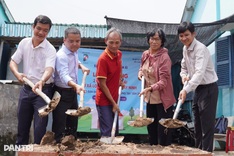
The renovation of a volunteer stilt house is currently under way in a valley next to the farm. The house will provide a base for future volunteer projects, including the planting of a mixed fruit and hardwood jungle that is planned to serve as a tourist attraction and restore a large area of land to a more indigenous state.
A new non-governmental organisation called Green Vietnam Foundation, Inc., now in the final stages of registration with the government, intends to support GVF in its efforts to propagate green farming techniques through the region, as well as to establish new sustainable operations in Vietnam.
According to founder John Berlow of the U.S., the foundation aims to raise funds “with the twin objectives of improving the environment and reducing poverty.”
Ultimately, he says, the hope is to see more farms like GVF become self-sustaining and farmers empower themselves with eco-conscious technology and resources that will raise their standard of living as they contribute to environmental protection.
More information about Green Vietnam Farm can be found at www.greenvietnamlodge.com.
More information about Green Vietnam Foundation, Inc. can be found at www.hr71.wikidot.com by following links to Green Vietnam.