Australia is emerging as a promising destination for Vietnamese goods, with businesses being urged to make better use of free trade agreements while raising their environmental and product standards.
Two-way trade between Vietnam and Australia reached USD 9.79 billion in the first seven months of 2026, up about 22 per cent from the same period last year, according to figures presented by the Ho Chi Minh City Investment and Trade Promotion Centre (ITPC) at a September 30 seminar on export opportunities in Australia.
Vietnamese exports to Australia were worth about USD 4.6 billion, an increase of nearly 30 per cent.
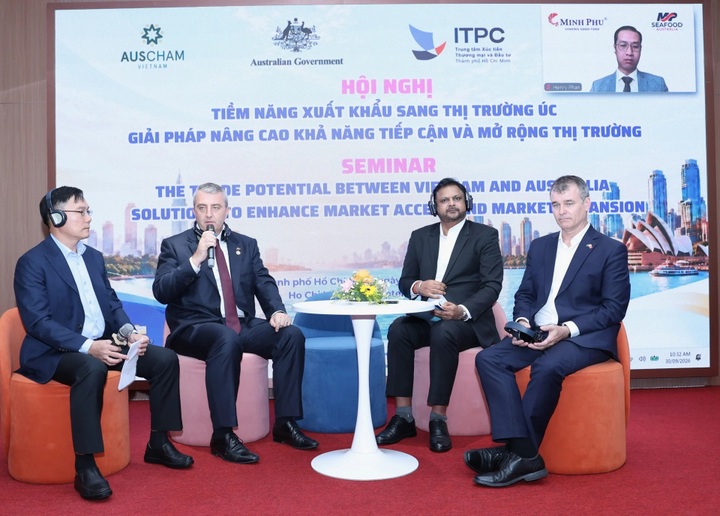
Experts discuss export potential in the Australian market at an ITPC event on the morning of September 30 (Photo: ITPC).
For Ho Chi Minh City, two-way trade with Australia reached USD 1.56 billion in the first nine months of the year, with exports totalling USD 985 million, up 16.3 per cent year on year.
Data from the World Trade Organisation cited by ITPC showed that Australia's total merchandise imports were worth about USD 308.7 billion in 2025. Vietnam supplied around USD 8.48 billion, giving it about 2.7 per cent of Australia's import market.
The figures point to substantial room for expansion, particularly because the two economies have largely complementary trade structures. Vietnam is competitive in manufactured goods, consumer products, agricultural produce and processed food, while Australia supplies energy, minerals and industrial inputs.
Sam Conroy, chairman of the Australian Chamber of Commerce in Vietnam (AusCham), said Vietnamese goods exports to Australia increased 88 per cent between 2020 and 2025.
Several product categories recorded particularly strong growth in 2025, including toys and sporting equipment, up 76.2 per cent; coffee, 42.6 per cent; and fruit and vegetables, 28.9 per cent.
The next opportunities could lie in processed and convenience foods, organic products, Halal-certified goods, construction materials and environmentally friendly furniture, experts said.
Australia's large and growing e-commerce market also offers Vietnamese businesses a relatively low-risk way to test demand before committing to larger distribution networks.
According to Australia Post, Australians spent AUD 82.6 billion online in 2025, up 14 per cent year on year, while 9.8 million households, 82 per cent of the country's total, made online purchases.
Smaller products at accessible price points can reach Australian consumers through cross-border platforms such as Amazon and eBay, giving Vietnamese companies an opportunity to test the market before expanding their operations.
But Conroy cautioned businesses against competing primarily on price. Australian buyers increasingly value quality, reliability and delivery performance, while suppliers are also expected to demonstrate compliance with standards, certification requirements and environmental criteria.
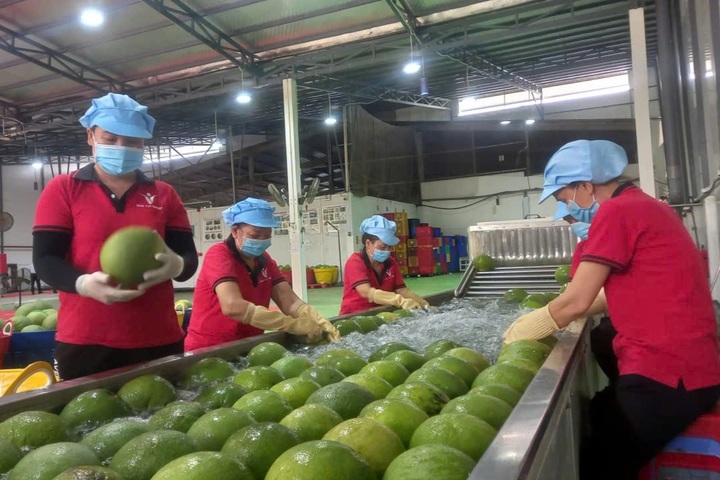
Vietnamese green-skin pomelo was recently exported to Australia but shipments had to be suspended after failing to meet some of the market's technical requirements (Photo: Nam Binh).
Nguyen Manh Hiep, commercial consul and representative of the Vietnam Trade Office in Australia, urged Vietnamese companies to make better use of the three free trade agreements shared by the two countries: AANZFTA, the CPTPP and RCEP.
Many tariff lines have already been reduced to zero, but companies must meet rules of origin and maintain complete documentation on their inputs to qualify for preferential treatment. Australian customs authorities can conduct post-clearance checks to verify compliance.
Matt Lourey, chairman of Alitium and a member of AusCham, said meeting rules of origin for preferential tariffs did not automatically mean a product was cleared for sale in Australia.
Goods must also comply with requirements covering customs, biosecurity, food hygiene, product safety, social responsibility and environmental protection. ESG, environmental, social and governance standards, is increasingly being extended to small and medium-sized suppliers.
Businesses should therefore check technical and regulatory requirements at the design, production and packaging stages rather than waiting until an order arrives, experts said.
Another challenge is Australia's highly concentrated retail sector, dominated by major chains such as Woolworths, Coles, Aldi and Bunnings Warehouse. Companies seeking to become direct suppliers need sufficient production capacity, reliable delivery and the ability to meet multiple standards.
For small and medium-sized businesses, the Vietnam Trade Office in Australia recommends stronger cooperation within individual industries to build supply capacity and improve their bargaining position.