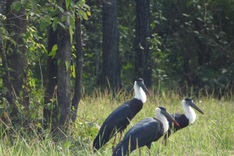
Six red-crowned cranes, approximately six months old, will be transported by air from Thailand to Vietnam on June 23 before being transferred to the Tram Chim National Park in Dong Thap Province for quarantine and health checks.
Nguyen Van Lam, director of Tram Chim National Park, said the group consists of two males and four females weighing between 5.3kg and 6.7kg. The birds are currently being raised at Nakhon Ratchasima Zoo in Thailand. Four Thai specialists will accompany the cranes and monitor their health during transportation and their initial adaptation period in Vietnam.
Preparations for the arrival have been underway for several months. A dedicated enclosure for juvenile cranes has been completed, while soil in the grass-growing area has been ploughed and left to dry for about one month to ensure suitable conditions.
The Dong Thap provincial government has requested support from customs authorities and Tan Son Nhat International Airport to expedite clearance procedures. A climate-controlled vehicle will collect the cranes directly from the airport cargo area and transport them to Tram Chim.
Upon arrival at the national park, the birds will undergo quarantine and veterinary inspections before joining the existing flock. This will be the first time Tram Chim has independently carried out the full quarantine and acclimatisation process after becoming a member of the international zoo association.
The transfer marks the second phase of Dong Thap's red-crowned crane conservation project. Five cranes received in April 2025 are reported to be developing well, with individual weights ranging from 5.4kg to 7.2kg. The birds have already formed breeding pairs, and experts expect them to produce their first offspring within the next year.
Another batch of cranes is expected to arrive later this year.
Under the conservation programme, Dong Thap aims to raise and release 100 red-crowned cranes over the next decade, including 60 birds transferred from Thailand. The province hopes that at least half of the released cranes will survive, reproduce and establish a self-sustaining wild population.