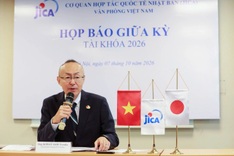
According to Tran Huu Minh, deputy director of the Transport and Traffic Safety Department under the Ministry of Construction, said the transition to cleaner road transport had achieved positive results in recent years.
The number of electric cars and motorcycles has risen sharply since 2022, helping reduce greenhouse gas emissions and improve air quality, Minh said.
As of the end of May, Vietnam had more than 374,800 electric vehicles in operation, including over 1,570 electric buses, nearly 369,850 electric passenger cars and about 3,400 electric trucks.
To promote greener transport through 2030, the ministry plans to focus on sectors with strong potential to reduce emissions, particularly rail and road transport.
The ministry will develop criteria for green rest stops, railway stations, seaports, inland waterway ports and airports. The standards are expected to be completed in 2026, followed by pilot implementation and wider adoption from 2027.
Minh said charging infrastructure remained one of the biggest barriers to wider EV adoption. Charging times, investment costs and operating expenses also remained concerns for businesses and consumers.
To address these challenges, the ministry plans to review and amend Prime Ministerial Decision No. 876/QD-TTg, issued in July 2022, which sets out Vietnam's roadmap for transitioning to green transport and reducing emissions.
The ministry will also work with local authorities to incorporate green transport infrastructure into urban planning, including EV charging networks and facilities for non-motorised transport.
In addition, it plans to develop criteria for green-smart cities following the introduction of a smart city framework.
Regarding urban rail development, Minh said the ministry was coordinating with local governments to review plans in line with the revised Railway Law and National Assembly Resolution No. 188/2025/QH15.
Urban railway projects will be developed under the transit-oriented development (TOD) model, which promotes urban growth centred on public transport.
The ministry is also accelerating preparations for metro projects in Hanoi and Ho Chi Minh City while drafting a transport services development strategy through 2035, with a vision to 2050.
Other initiatives include plans to enhance container transport capacity along the Hai Phong–Viet Tri inland waterway corridor and improve connectivity among ports in the country's fourth seaport cluster.
The ministry said it would prioritise integrated transport infrastructure, modernise railways and strengthen multimodal connectivity to reduce reliance on road transport.