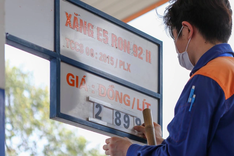
Head of the Ministry of Finance's Price Management Department, Nguyen Anh Tuan, talks about their efforts to control the prices of essential products including petrol and electricity.
 |
| Nguyen Anh Tuan |
According to Tuan, even though the price of electricity was increased by 5%, and the price for coal, education and healthcare were also up, this did not affect the CPI last year thanks to close collaboration between agencies.
"Despite the volatile world fuel market, domestic prices were kept relatively stable in order to control inflation. We also publicised the usage and distribution of price stabilisation funds so that people could see for themselves and have a better understanding about our work. We've been praised for our heightened transparency," he said.
In 2013, the Ministry of Finance also tightened management of products and services that use the state budget. They removed many expenditures that violate regulations. In addition, Tuan said stimulus packages would continue to show their effectiveness in 2014, helping to improve businesses' and customers' confidence in economic recovery.
The National Assembly approved of a targets of 5.8% GDP growth and a 7% CPI increase for this year.
However, he also expressed worries about a possible spike in inflation because several stimulus packages and support policies from last year are behind schedule while the country still has to face events such as natural disasters and crop and livestock epidemics. "We need to keep an eye on supply and demand of both domestic and global markets to stabilise prices in a timely way. In the meantime, we need to encourage fair competition so customers will be able to make reasonable choices."
Tuan went on to say that the agencies must carry out more price inspections and authorities at all levels must collaborate to issue viable solutions to control inflation. All of the policies and solutions must be publicised along with the agencies' management methods.