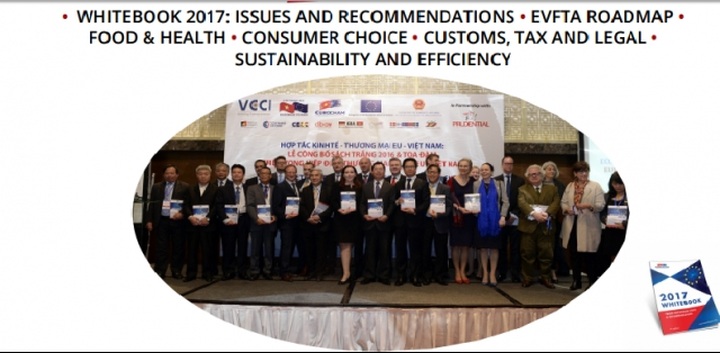
Ninth edition of collective views of EuroCham members released on March 2. Photo: Eurochamvn.org
The experts, however, indicated that the guidelines for several new laws have not yet been issued and the processing of documents for investors remains complicated.
At the conference, Deputy Minister of Industry and Trade Hoang Quoc Vuong said the EuroCham Whitebook is a good opportunity for the ministry to offer reasonable solutions to enhance the effective management and development of the business environment in Vietnam, creating favorable conditions for domestic and foreign enterprises.
This 9th edition of the EuroCham Whitebook is a collective expression of the views of EuroCham member companies, which operate in a wide range of industries. The publication echoes the European business community’s desire to support the Vietnamese Government in the development of the current legal framework and a positive business environment in Vietnam, for the benefit of companies, investors and society.
Experts from EuroCham Sector Committees identified many shortcomings in the county’s business climate. “The unreasonable imposition of price ceilings in the past few years has had a significant impact on dairy companies,” said Mr. Arnaud Renard, Chairman of the Nutritional Foods Group. “The market declined both in sales volume and revenue. One company had to shut down and withdraw from the Vietnamese market.”
“We would recommend that, foremost, the State remove the price ceilings policy on milk products, while in the long run it considers and enforces policy measures that can help businesses lower unit costs (e.g. import duties, value-added tax, etc.) rather than focusing on policies that interfere directly on the market, as is currently done,” he added.
“For 2017 the government has set an ambitious export figure for agricultural products ($30 billion),” said Mr. Alexander Kliegl, Chairman of the Food, Agri and Aqua Business Sector. “Exports will grow thanks to increased demand, diversification, extended technology, promotion, investment, and the impact of the EVFTA. If not addressed, Vietnam’s reputation for bad food safety will impact this goal negatively.”
“To keep, or improve, its position as an agricultural producer and exporter, Vietnam also needs to develop a sustainable production and supply chain,” he added. “This will help to increase the scale and quality of produce, food safety, and the farmers’ position, and reduce the carbon footprint as well.”
Underlining the significance attributed by the Vietnamese Government to the EVFTA, Deputy Minister Vuong addressed participants in his opening remarks.
H.E. Bruno Angelet, Ambassador and Head of the EU Delegation, highlighted in his key note address that the trade pact represents an important milestone in bilateral commercial, economic and investment links between Vietnam and the EU.
Similarly, Mr. Vu Tien Loc, President and Chairman of the Vietnam Chamber of Commerce and Industry (VCCI), emphasized in his key note address the future impact of the EVFTA both for Vietnamese and for foreign enterprises, and welcomed the initiative to cooperate even closer with EuroCham.
EuroCham Chairman Mr. Michael Behrens stated in his key note address that the bilateral treaty with the EU was another step forward in further integrating Vietnam into the global economy.
Figures from General Department of Vietnam Customs show that the EU is the second-largest export market for Vietnam, with export turnover of nearly $34 billion in 2016, accounting for over 19 per cent of the total.