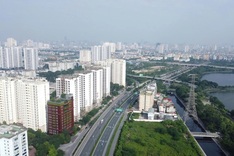
Many customers of Lilama Joint Stock Company in Hanoi complained that they were forced to buy apartments with larger areas than those stated in contracts they signed.
The apartments belong to a project including offices, trade centres and apartments at No. 52 Linh Nam, Hanoi. The project is six months behind schedule, and Lilama admitted that they cannot hand over the apartments to the buyers on December 31, as planned.

Lilama Hanoi's project at No. 52 Linh Nam lags behind schedule
Increasing area means a boon to the company
Mrs. Pham Thi Quang, who signed a contract to buy an apartment in March of 2011, was shocked after receiving the company’s notice, in which stated that her apartment had increased size from 81 to 115 square metres. The company did not inform her of the changes, and the contract did not have any stipulations regarding this except for the pace of construction.
Nguyen Duy Hai, Director of real estate projects of Lilama Hanoi, said, the minimum increase of area was five square metres and the maximum was 24. He explained that, “The project turned out to be unprofitable so we expect sympathy from customers.”
He also said that the legal foundation for the increase in area had approval from the authorities. According to Lilama, the area increase has received customers’ agreement too. But in an interview with DTiNews, Hai admitted that 10% of the customers did not agree, and had not signed to the commitments.
The authorities have given a license for the company to increase the apartment area, so they are unable to withdraw in order to meet the demands of the remaining 10%, he said.
While trying to persuade the buyers to agree, Lilama has shocked a number of them with higher prices than they signed for.
Interest on top of hidden fees
Mr. Tung, who was forced to add buy five extra square metres to his apartment, complained that, “Lilama increased the area without our approval. We signed contracts, but they are requiring us to pay more money for their mistake."
The money for the increased area is also considered 'initial area', requiring buyers to pay fees that are subject to interest plus a 10% fine for late payment.
At the same time the project is lagging behind schedule, and the invesor cannot say for sure when they will be able to hand over the apartments.
Bui Quang Hung, of BQH Law Offices, said that capital appropriation is something that is often seen in the case where investors have limited financial capacity. He added that, under current regulations, customers only have to hand over 70% of the contract's entire value to begin the transaction, with the rest to be paid upon receival of the property. In this case, buyers paid 95%, and have the right to sue the company, he said.
An expert from the Federation of the Civil Engineering Association said, “The initial contract signed with customers has the highest legal value. Any additional terms must be based on the initial contract, with agreement from the buyers. In this case Lilama Hanoi increased the apartment area unilaterally. Designs of apartments were also changed without prior approval from the buyers. At the same time the buyers were held to the terms of a contract which they die not sign."