Accordingly, the investors would be exempt from the land ownership transfer tax and corporate income tax. People who buy low-income houses will also get a value-added tax and registration fee exemption.
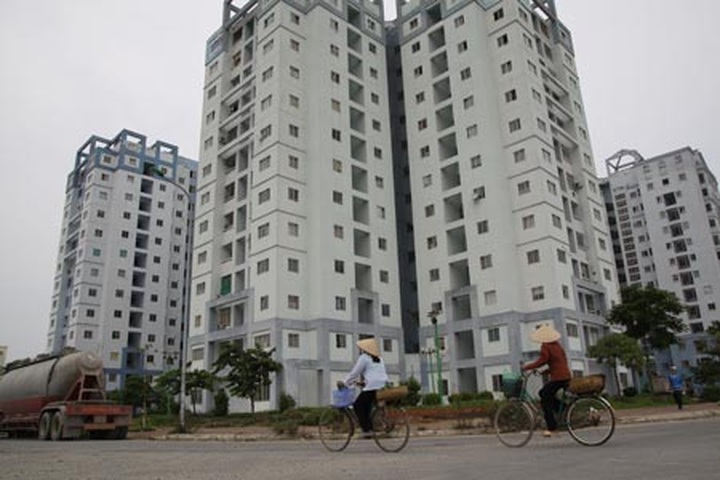
Millions of low-income earners in cities cannot afford to buy homes.
Difficulties in purchasing low-income housing
According to VAFI, currently, millions of low-income earners in cities cannot afford to buy homes.
In recent years, lending interest rates fluctuated between 15% - 25%. This posed obvious challenges for families who are struggling. At the same time local land funds do not allocate the stipulated 20% to social housing projects.
Because of budget shortfalls, the state has been unable to carry out its plan to increase accommodation for those who earn the least, leaving many without adequate shelter.
Also, there continues to be a significant amount of red tape and administrative obstacles surrounding the purchase of such homes. Some people even take advantage of the system in order to sell them for higher prices.
In Hanoi the price of "low-income" apartments often remains too high to attract buyers.
The Construction Joint Stock Company No. 3 (Hanco 3) has only managed to sell 30 apartments out of 130 in one of their projects in Sai Dong, Gia Lam District, despite holding a second lottery to deal with the high number of potential customers.
Official prices for low-income earners currently stand at VND13 million (USD619) per square metre compared to common market prices of VND14-15 million per square metre.
Investors must be enticed
VAFI said investors of low-income housing projects should be offered construction tax and fee exemptions, as well as preferential loans, in order to decrease prices by 30-40% to VND350-700 million (USD16,600-USD33,300) per home, with area from 35-70 square metres.
The association also recommended that a bank, in which the state has a majority share, should be assigned to provide these preferential loans. This has been done in the past in other developing countries such as Thailand and Indonesia, as well as in developed countries like the US, UK and France.
VAFI believed that these measures would attract more investors to develop affordable housing projects, and decrease the average price of an apartment to around USD20,000.