Authorities in Danang have received more than 500 reports pointing to 320 suspected burial sites containing the remains of Vietnamese war martyrs, recovering 29 sets of remains since the beginning of 2026.
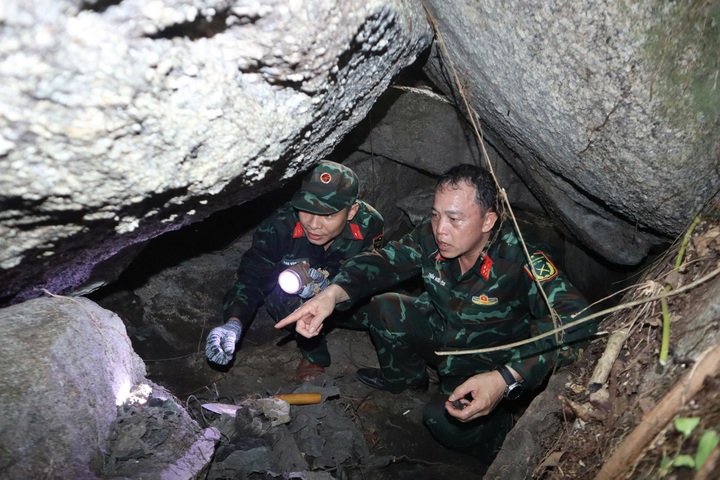
Authorities search for martyrs' remains at Da Sap cave (Photo: A Cuong).
The Danang Military Command said it had processed more than 500 information leads, conducted over 100 field surveys and identified 320 locations requiring excavation as part of the search for missing war martyrs.
Since January 2026, search teams have recovered the remains of 29 martyrs.
As part of efforts to identify the fallen through DNA analysis, Danang currently has 144 war cemeteries containing 25,485 graves from which biological samples are expected to be collected for forensic testing.

Tran Anh Tuan, vice chairman of the Danang City People's Committee (Photo: A Cuong).
As of July 27, authorities had excavated 4,973 graves and collected 2,304 biological samples, equivalent to 46.33 per cent of the planned total.
Of those, 891 samples have been transferred to the National Institute of Forensic Medicine for DNA analysis aimed at identifying previously unknown war martyrs.
The Danang Military Command said it aims to verify 100 per cent of information provided by organisations and individuals to support the search, recovery and identification of martyrs whose identities remain unknown.
Search efforts will focus on areas where significant information or evidence has been reported, including Doc Ong Thu, Y10 Hospital, Doc May, cemeteries in Ha Nha Commune, Hiep Duc Commune and Nui Thanh Commune, as well as Hon Tau Mountain, Hang Cay Khe and Ranh Hoa Binh.

Martyrs' remains found at Da Sap Cave (Photo: Hoai Son).
According to the Danang Military Command, Tran Anh Tuan, vice chairman of the Danang People's Committee, has instructed relevant agencies to mobilise maximum personnel and resources to accelerate biological sample collection, with the goal of completing the work by September.
He also directed authorities to expand search and recovery operations in key areas where information and physical evidence remain abundant, with the aim of completing the mission by July 27, 2027.