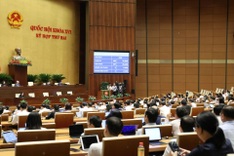
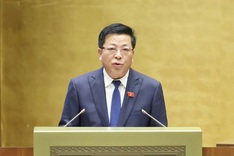
Construction Minister Tran Hong Minh, authorised by the Prime Minister, on November 7 submitted proposals for three expressway projects to the National Assembly.
The projects comprise the Moc Chau-Son La-Dien Bien Expressway section in Son La Province, the Bao Ha-Tan Phong section of the Bao Ha-Lai Chau Expressway, and the Quang Ngai-Kon Tum Expressway.
According to the government's submission, the three expressways will have four lanes, with design speeds of 80-100 kilometres per hour, depending on the route.

Their combined preliminary investment is estimated at VND 162.4 trillion, including more than VND 158.3 trillion from the central government budget.
Project preparations are planned for the 2026-2027 phase, with compensation, resettlement and construction starting in 2027. The expressways are expected to be largely completed by 2030 and open in 2031.
Three expressways to strengthen regional connectivity
The longest project is the nearly 180-kilometre Moc Chau-Son La-Dien Bien Expressway section in Son La Province, with an estimated investment of VND 63.12 trillion.
The project aims to improve connections between Son La, Hanoi and neighbouring localities while gradually completing the expressway network in the northern midland and mountainous regions.
The Bao Ha-Tan Phong section of the Bao Ha-Lai Chau Expressway will stretch approximately 119 kilometres through Lao Cai and Lai Chau provinces, with an estimated investment of VND 50.99 trillion.
It is expected to improve Lai Chau's connections with Hanoi and neighbouring provinces while addressing shortcomings in existing transport infrastructure, particularly disruptions caused by landslides in mountainous areas.
The Quang Ngai-Kon Tum Expressway will extend approximately 132 kilometres within Quang Ngai Province, with an estimated investment of nearly VND 48.3 trillion.
The project is intended to strengthen east-west connectivity by linking the eastern and western North-South expressways and improving access between the Central Highlands and seaports along the eastern coast.
Minister Minh said early investment was needed as existing highways linking mountainous areas to regional economic centres had limited capacity and were frequently disrupted by natural disasters.
The expressways are expected to cut travel times by 50-60 per cent, boosting trade, production and tourism while supporting poverty reduction, national defence and security.
Public investment proposed as BOT cost recovery proves difficult
The government has proposed implementing all three projects through public investment.
According to the submission, public-private partnership (PPP) arrangements under build-operate-transfer (BOT) contracts had been examined.
However, financial calculations showed that even with state funding covering 50-70 per cent of total investment, a viable investment recovery period could not be determined.
The government also noted that the proposed expressways would pass through mountainous and border areas facing difficult socio-economic conditions and home to substantial ethnic minority populations.
The projects were considered important for regional connectivity, national defence and security.
To speed up implementation, the government proposed five sets of special measures covering investment approval adjustments, compensation and resettlement, direct contractor appointments, planning changes and construction waste disposal sites.
Notably, the government proposed allowing direct contractor appointments for project packages, with procedures to comply with procurement legislation.
The expressways were expected to address infrastructure bottlenecks, expand development opportunities and strengthen regional connectivity.
However, the committee urged the government to further review investment estimates, funding availability and implementation arrangements, particularly the funding expected to be allocated after 2030.
For the Bao Ha-Lai Chau project, the committee recommended considering full funding from the central government budget to ease financial pressure on Lai Chau Province and enable local authorities to invest in connecting roads.
Regarding the Moc Chau-Son La-Dien Bien Expressway, the committee noted that approximately 4,970 households would be affected, including around 920 requiring relocation to designated resettlement areas.
It called for living conditions at resettlement sites to be at least equal to those at residents' previous homes.
For the Quang Ngai-Kon Tum Expressway, several opinions called for further route optimisation to minimise the conversion of natural forest land, particularly upstream protection forests.
On the proposed special measures, the committee urged caution over expanding direct contractor appointments.
It recommended competitive bidding for packages where competition was feasible, reserving direct appointments for exceptional and genuinely necessary cases to ensure transparency and efficient use of public funds.
The committee also called for clearly defined conditions and limits for the special measures, stronger oversight and safeguards against financial losses and waste during project implementation.