
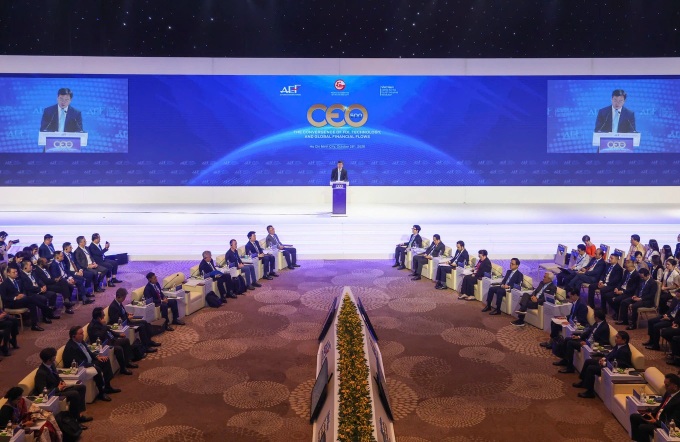
Ho Chi Minh City Vice Chairman Nguyen Cong Vinh outlined the strategy at the CEO 500 Forum, themed "Convergence of FDI, Technology and Global Financial Flows", attended by over 500 business leaders and representatives of international organisations, financial institutions and government agencies.
The event was held as part of the Autumn Economic Forum 2026 (AEF 2026) in Ho Chi Minh City.
Vinh noted that investment decisions increasingly depend not just on market size or incentives but also on infrastructure, energy, workforce quality, supply chain links, capital market access and regional expansion opportunities. In response, the city is focusing on four key areas of cooperation.
The city is prioritising transport links, transit-oriented development (TOD), seaports, logistics and free trade zones, seeking investors with the capital, technology and expertise to deliver large-scale projects.
In finance, the Vietnam International Financial Centre in Ho Chi Minh City (VIFC-HCMC) aims to channel international capital into regional development, with foreign financial institutions invited to explore participation requirements, procedures and timelines from an early stage.
"A stable supply of clean electricity is vital to attracting industrial and high-tech investment. The city aims to work with investors on priority locations, sectors and timelines for energy projects," Vinh said.
In the digital economy and technology sector, the city plans to develop data infrastructure and high-tech parks, promote artificial intelligence (AI) applications and establish regulatory sandboxes for emerging technologies.
According to Associate Professor Nguyen Huu Huan, vice chairman of the executive body of VIFC-HCMC, the next phase should focus not only on increasing investment flows but also on improving investment quality and the value generated within the economy.
Vietnam recorded USD 50.36 billion in registered foreign direct investment (FDI) in the first nine months of 2026, while disbursed FDI reached USD 21.07 billion.
The foreign-invested sector remains important to manufacturing and exports, but strong export figures do not necessarily mean Vietnamese businesses control the technology involved or capture a proportionate share of added value.
The Organisation for Economic Co-operation and Development (OECD) showed that foreign value added accounted for about 48 per cent of Vietnam's exports in 2020, against 52 per cent from domestic sources, including foreign-invested firms operating in Vietnam.
"This reflects heavy reliance on imported materials, components and assembly. To retain more value, Vietnam must focus on research, design, core technologies, intellectual property and branding," Huan hilighted.
He proposed that VIFC-HCMC direct international capital towards higher-value sectors, including AI, semiconductors, automation, robotics, digital technology, digital finance, biotechnology and green technology.
Investment attraction should be linked to research and development (R&D), engineering training, technology transfer and greater participation by Vietnamese businesses in supply chains.
From a banking perspective, Vo Hoang Hai, deputy chief executive of Nam A Bank, argued that an international financial centre could deliver real value only if capital reached businesses.
Large projects may require financing amounts or loan maturities beyond the capacity of individual banks, making syndicated financing arrangements increasingly important.
Hai recommended that VIFC-HCMC support participating institutions in completing one or two syndicated financing transactions over the next two years, connecting Vietnamese businesses with international capital.
Initially, the centre could bring together domestic banks, foreign lenders, legal advisers and other partners to agree on business selection criteria, transaction requirements and coordination arrangements.
He suggested that VIFC-HCMC act as a coordinator, connecting participants and helping address legal, foreign exchange, cross-border capital flow and reporting issues.
Success could be measured by the amount of capital disbursed, the participation of international institutions and the time required to complete transactions.