
Vietnam’s National Centre for Hydro-Meteorological Forecasting said Champi was located at about 18.1°N, 130.2°E on the morning of October 21, with winds reaching level 17 and gusts above level 17 on Vietnam’s storm intensity scale. The typhoon was about 800km east-south-east of Luzon in the Philippines.
The latest satellite analysis puts Champi’s maximum sustained winds at about 210km/h, equivalent to a category 5 hurricane under the US system.
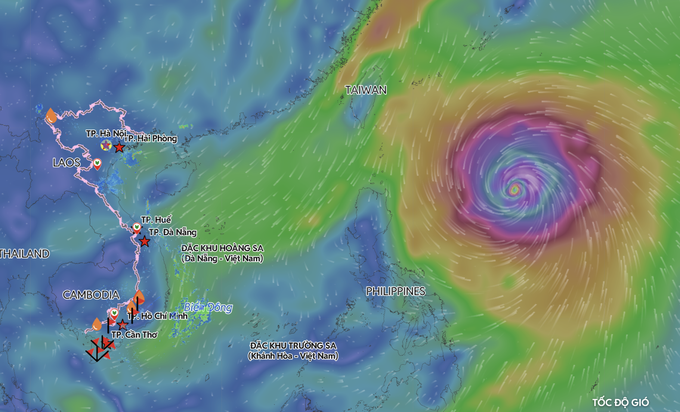
Super Typhoon Champi is considered one of the strongest storms in the north-west Pacific in 2026 (Photo: Disaster monitoring system).
It is now considered the strongest storm in the north-west Pacific in 2026, surpassing super typhoon Sinlaku. Champi has a clearly defined, fairly symmetrical eye about 80km wide.
Meteorologists said the storm was moving over waters with surface temperatures of 29-30 degrees Celsius, conditions favourable for maintaining its intensity. Over the next 24 hours, it is forecast to remain at level 17, with gusts above level 17, while moving mainly west-north-west at about 20-25km/h.
From October 22, Champi is expected to turn gradually towards the north-west. As it moves north over cooler waters, the storm is forecast to weaken.
International forecasting agencies in Japan, South Korea, China and the US have increasingly converged on Champi’s projected track over the past two days. Their latest forecasts suggest the storm is unlikely to make a direct landfall in Taiwan.
By about October 24, when Champi reaches waters east of Taiwan, China, its intensity is forecast to fall to level 10, with gusts at level 13. It may then turn north-east towards Japan and South Korea.
By October 25, as it approaches southern Japan and South Korea, Champi is expected to weaken further to level 8, with gusts at level 10.
Vietnam’s meteorological agency said Champi was not expected to enter the East Sea. However, given its intensity of levels 16-17 and its broad wind field, the storm’s western circulation could bring winds of levels 6-7, gusting at levels 8-9, and waves of 2-4 metres to the north-eastern part of the East Sea’s northern waters.