
Vietnam imported 112,090 tonnes of fresh, chilled and frozen pork worth USD 185.54 million during the first seven months of the year, according to the Import-Export Department.
Import volumes rose 27.1 per cent compared with the same period last year, while the total value of imports fell 20.9 per cent, reflecting a sharp decline in global pork prices.
The average import price stood at USD 1,638 per tonne, equivalent to roughly VND 43 million per tonne, or about VND 43,000 per kilogramme. This represented a decline of 38.4 per cent compared with the same period in 2025.
Imported pork remains significantly cheaper than domestic products, which currently retail at between VND 70,000-145,000 (approximately USD 2.66-5.51) per kilogramme.
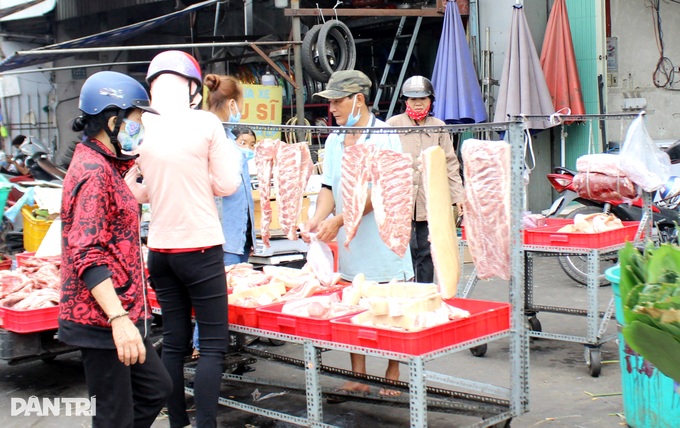
Consumers buy frozen pork at a traditional market in Tam Binh Ward, Ho Chi Minh City (Photo: Nam Binh).
Hoang Manh Hung, a representative of a food import-export company based in Tan Thoi Hiep Ward, Ho Chi Minh City, said imported pork is available in a wide range of cuts and products.
"In the past, imported pork was supplied mainly to restaurants, eateries and industrial kitchens," Hung said. "Today, after processing and packaging, imported products are increasingly reaching retail consumers directly."
The growing acceptance of imported pork has been driven by its lower price and wider product selection, particularly among budget restaurants, catering services and large-scale industrial kitchens that require substantial volumes.

Imported Brazilian pork ribs are VND 50,000-60,000 per kilogramme cheaper than domestic ribs (Photo: Nam Binh).
Nguyen Kim Doan, vice-chairman of the Dong Nai Livestock Association, said live hog prices in Brazil are currently about half those in Vietnam.
He attributed the cost advantage to Brazil's highly competitive feed industry, supported by some of the world's largest corn and soybean harvests.
Brazil remains Vietnam's largest supplier of imported pork, accounting for 44.5 per cent of total import volumes.
According to Doan, the combination of low-priced imports and rising import volumes is creating direct competition for domestic livestock producers, many of whom are already struggling with increasing production costs.
A report from the Ministry of Agriculture and Environment also showed that domestic live hog prices continued to weaken in July due to abundant supply and sluggish consumer demand.
The ministry said pressure from imported meat, together with softer market demand, has contributed to downward price trends in Vietnam's pork sector, posing additional challenges for local farmers.