
Vietnam has emerged as one of Southeast Asia's leading adopters of artificial intelligence (AI), with usage rates rising rapidly as the country accelerates its digital transformation agenda.
Speaking at Signify Innovation Day 2026 in Ho Chi Minh City on August 20, Dutch Consul General Raissa Marteaux said Vietnam had demonstrated a remarkable ability to adopt new technologies at speed.
“Vietnam has shown an extraordinary capacity to deploy new technologies,” Marteaux said. “The next opportunity is to make these systems smarter, better integrated and more efficient.”
Vietnam is targeting double-digit GDP growth from 2026 while pursuing sustainable development goals and a commitment to achieve net-zero emissions by 2050.
Dang Hai Dung, deputy director of the Department of Innovation, Green Transition and Industrial Promotion under the Ministry of Industry and Trade, said these objectives represent a broad transformation of the economy rather than a series of separate targets.
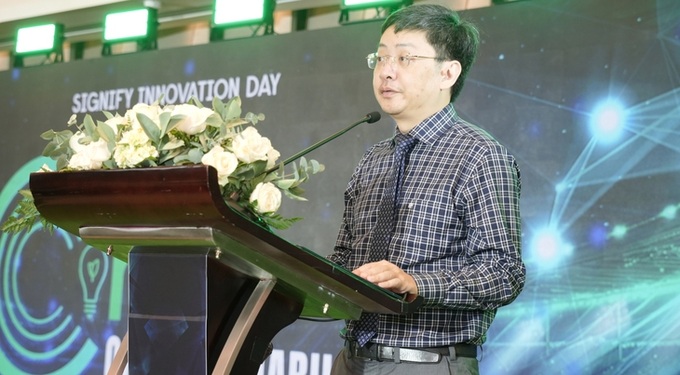
Dang Hai Dung, deputy director of the Department of Innovation, Green Transition and Industrial Promotion under the Ministry of Industry and Trade, speaks at Signify Innovation Day 2026. (Photo: Organising committee).
According to Dung, the transition encompasses energy, manufacturing, infrastructure and consumer behaviour, requiring businesses to embrace technological innovation and digital transformation while improving operational efficiency and complying with government regulations.
Vietnamese companies have increasingly invested in technology upgrades and digital solutions as part of these efforts.
Data from Microsoft's Global AI Diffusion Report, published in June 2026, showed that AI adoption in Vietnam rose steadily from 21.2 per cent in the first half of 2025 to 23.5 per cent in the second half of the year, before reaching 26.5 per cent in the first quarter of 2026.
The 3-percentage-point increase recorded in the first quarter of 2026 was the highest in Southeast Asia, surpassing Singapore's increase of 2.5 percentage points.
In absolute terms, Singapore remained the regional leader, with 63.4 per cent of working-age people using generative AI. Vietnam ranked second at 26.5 per cent, ahead of Malaysia at 21.8 per cent, the Philippines at 20.1 per cent and Indonesia at 14.1 per cent.
The figures highlight Vietnam's growing role as a regional technology hub as the country seeks to harness AI and innovation to support long-term economic growth and sustainability goals.