
As Vietnam’s livestock sector targets billion dollar exports, businesses are accelerating efforts to turn agricultural waste into animal feed and other value added products.
Speaking at the ILDEX Vietnam 2026 exhibition, Tran Ngoc Thi, quality director of Marine Biotech Vietnam, said the company is expanding production of protein powder products made from Vietnamese agricultural byproducts.
The products include protein extracted from shrimp heads and marine fish protein, which are being sold strongly in the domestic market and exported to China and Europe.
Marine Biotech Vietnam opened its first factory in Ben Luc in Tay Ninh Province in 2024 and is preparing to build a second plant in the Mekong Delta raw material region.
According to Thi, the company focuses on recycling byproducts while applying new technologies to preserve nutrients found in raw materials such as shrimp heads and fish bones.
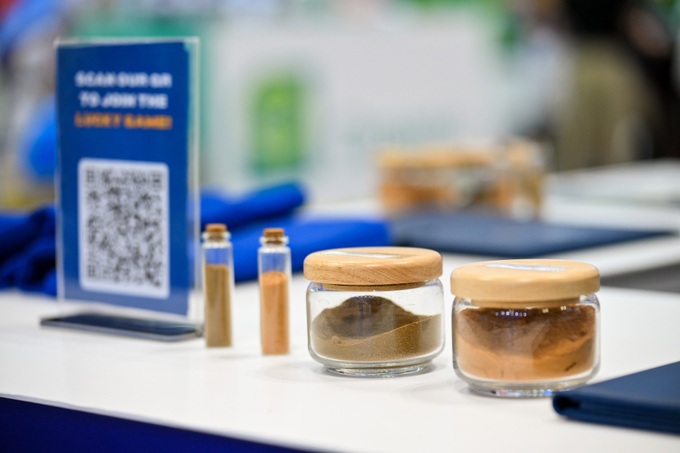
Marine Biotech Vietnam's protein powder products extracted from shrimp heads and marine fish were showcased at the ILDEX exhibition (Photo: Huan Tran).
The company has already supplied products to several major Vietnamese livestock feed and aquaculture feed manufacturers.
Each factory requires investment of around USD 5 million and is being developed in two phases.
Paul Vincent, factory director at Marine Biotech Vietnam, said the company initially imported products to introduce them to Vietnamese farmers and the local market before expanding domestic production using local raw materials.
“Once the market becomes stable, we can develop production directly in Vietnam to reduce costs and minimise waste from agricultural byproducts,” Vincent said.
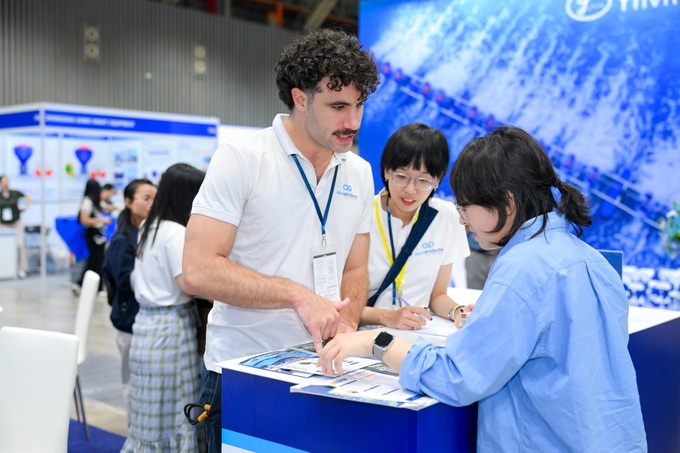
Paul Vincent, MBV's plant director, left, speaks with customers about the company's technology for extracting protein from Vietnam's agricultural by-products (Photo: Huan Tran).
The company said many seafood processing plants in the Mekong Delta currently extract only limited materials such as chitin from shrimp waste, while large quantities of liquid residue are discarded or released into the environment.
According to company research, Vietnam wastes around USD 2 billion each year by failing to fully utilise shrimp byproducts after harvest.
“If these materials were fully utilised, they could generate very significant revenue,” Tran Ngoc Thi said.
Other companies are also increasing investment in agricultural waste recycling.
De Heus said it is investing heavily in technology to process agricultural byproducts into livestock and aquaculture feed products.
Alongside corn cultivation projects in the Central Highlands, De Heus is developing a sustainable maize raw material zone capable of producing around 300,000 tonnes annually for feed production.
The company is also partnering with a Dutch firm in Tay Ninh Province to produce organic fertiliser through poultry waste recycling.
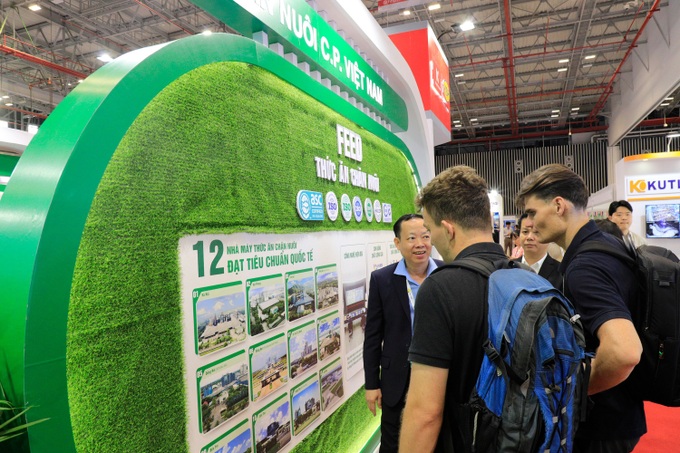
International visitors tour booths showcasing animal feed plants in Vietnam (Photo: Huan Tran).
Industry experts said Vietnam’s livestock sector has advanced rapidly in recent years thanks to the adoption of high technology across feed production, breeding, farming and processing operations.
Speaking at the opening of ILDEX Vietnam 2026, Phung Duc Tien, former deputy minister of Agriculture and Environment, said Vietnam’s livestock industry had achieved significant progress, particularly in applying advanced technologies and expanding exports to international markets.
Livestock product exports reached USD 245 million in the first four months of 2026, up 45.5 per cent year on year.
Tien said the sector could generate export turnover of USD 650 million to USD 700 million this year and eventually target USD 1 billion in the coming years.
He said investment in integrated production chains and scientific technologies would be essential to reduce waste and increase product value.
ILDEX Vietnam 2026, held in Ho Chi Minh City from May 20 to May 22, featured more than 230 companies and brands from 25 countries and territories showcasing solutions in animal feed, farming technology, veterinary services, biosecurity and agricultural byproduct recycling.