
The annual mong racing competition was held in Tran De Commune as part of the 2026 Nghinh Ong Festival, a coastal folk festival honouring the Whale God.
A mong is a handmade wooden board traditionally used by local fishermen to travel across the vast mudflats of the Mekong Delta’s coastal estuaries while collecting seafood.
Each board is a narrow wooden plank measuring roughly one metre in length and 30 cm in width, with one end curved upward to reduce friction and help it glide over thick mud.
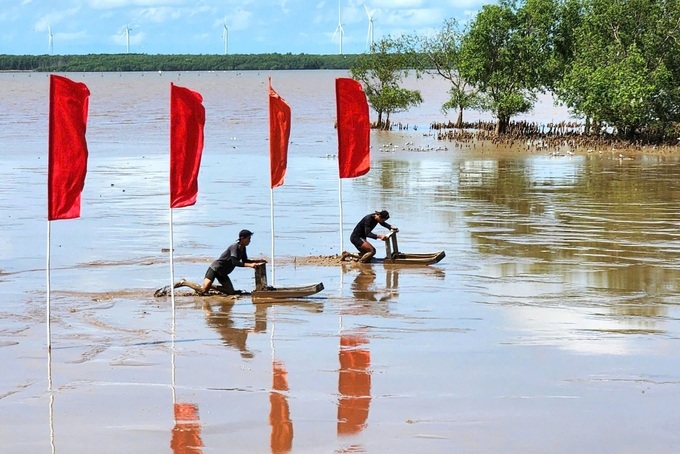
Racers propel themselves by kneeling or standing on the board with one leg while using the other to push against the mud, steering with both hands on the front handle.
Though appearing straightforward, the technique requires considerable balance, stamina and experience, participants said.
“With each strong push, an experienced rider can glide two to three metres,” local fisherman and competitor Son Hoang said.
After a series of tightly contested heats, Hoang claimed first place in this year’s event, drawing cheers from spectators gathered along the mudflat course.

The sport originated from the daily work of fishermen in Mo O hamlet, where heavy silt deposits and deep mud make walking difficult during low tide.
More than 100 local households still rely on mong boards to gather fish, crabs and blood cockles from the tidal flats, according to residents.
Local authorities have turned the once purely utilitarian practice into an annual competition in recent years to preserve the area’s distinctive coastal culture and attract visitors.
The Nghinh Ong Festival in Tran De was recognised as a national intangible cultural heritage by Vietnam’s Ministry of Culture, Sports and Tourism in 2019.