
A new era in Vietnamese sport is taking shape, with three FIFA-standard stadiums rising in Hung Yen Province, Hanoi and HCM City in the country’s most ambitious infrastructure upgrade in decades.
Each venue, with tens of thousands of seats, is set to reshape how Vietnam stages events, trains athletes and presents itself globally.
For years, Vietnam’s ambitions to host major international events were hampered by a lack of world‑class facilities. Now, planners and officials say, these mega‑projects could be the foundation that allows the country to bid for and stage continental and global tournaments from the Asian Games to a future World Cup, and to build a more complete sports ecosystem that extends beyond the pitch.
In Hung Yen Province, PVF Stadium, which began construction in October 2025, is being pitched as a technological revolution for Vietnamese football. Covering 55,000sq.m and seating 60,000, it is among the nation’s largest arenas and is being designed to meet the exacting standards required for events such as the Olympics and the World Cup.
PVF’s headline feature is an automated dome that opens and closes to protect players and fans from tropical downpours and searing heat. The stadium sits inside one of Asia’s leading youth training complexes, connecting elite facilities with a talent pipeline.
Organisers also stress the venue’s advanced safety and digital systems: dynamic emergency exits, voice alerts, AI‑powered CCTV that analyses crowd density and behaviour, and electronic ticketing with automated access control. Together these systems reflect a wider global push to digitise the spectator experience and to raise operational standards.
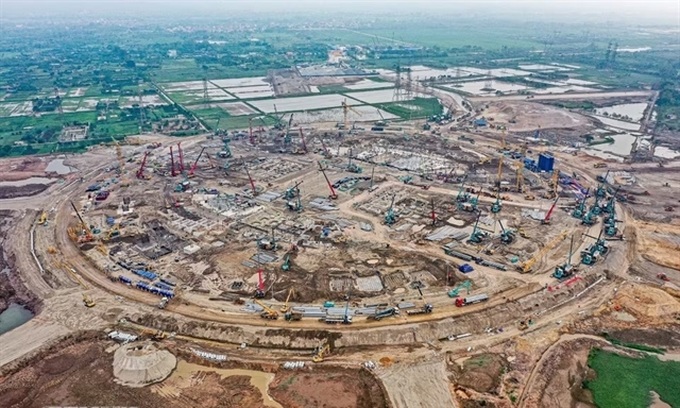
If PVF is a technological showcase, Trong Dong (Bronze Drum) Stadium in Hanoi is a statement of scale and national identity. Planned across roughly 73.3ha, the project proposes a capacity of up to 135,000 seats, which would surpass Narendra Modi Stadium in India and North Korea’s May Day Stadium as having the largest capacity worldwide.
The design draws on the Dong Son bronze drum, an emblem of ancient Vietnamese civilisation. Architects intend a fusion of traditional motifs and cutting‑edge engineering: a monumental, retractable roof, billed as the world’s largest, energy‑saving systems, and eco‑friendly materials.
Construction crews have been working around the clock since ground was broken last December, and the site has visibly transformed in a matter of months.
Planners say the stadium is being built to FIFA standards with the broader aim of positioning Vietnam to host the largest multi‑sport events.
Completion is scheduled for 2028, and backers argue the project could be the capstone that allows the country to bid for future World Cups or Olympic‑level competitions, possibly as a co‑host with neighbouring countries.
Meanwhile, in HCM City, the newly inaugurated Rach Chiec National Stadium forms the third pillar of this national upgrade. The 24ha complex, which opened in January, seats 70,000 and is equipped with a flexible roof, full air‑conditioning and modern soundproofing.
Rach Chiec is not just a single bowl: the project includes an 18,000‑seat multi‑purpose arena, an aquatic centre, a tennis complex and multi‑sport facilities, alongside a convention and exhibition centre, a sports hospital, green spaces and public plazas. The goal is a multifaceted venue that supports elite competition, mass participation and large cultural events.
Experts say the three stadiums represent a historic investment in the country’s sporting capacity.
“For many years, one of the major obstacles preventing Vietnam from hosting major tournaments has been the limited availability of internationally standardised facilities,” said Bui Hoai Son of the National Assembly’s Committee of Culture and Society.
The new venues could relieve pressure on the ageing My Dinh National Stadium, which has been repeatedly booked for entertainment events, limiting its availability for high‑performance sport.
With multiple world‑class options, the Vietnam Football Federation will be better able to match facilities to the requirements of a given match or tournament.
“Strategically, investing in sports infrastructure is investing in people,” said National Assembly deputy Truong Xuan Cu.
He argued that improved facilities would support public health, raise workforce capacity and strengthen national competitiveness. For young athletes, access to scientific training environments, standard pitches and integrated sports medicine could raise the quality of the national talent pool.
Challenges remained, however, Cu noted. Large projects would bring high costs, complex operations and long‑term maintenance commitments. Delivering social value would require transparent governance, sustainable financing and inclusive programming so that these venues would not become underused monuments but active engines of community and sport.
If managed well, these stadiums would be more than venues, they would become stages where a new sporting identity takes shape, where crowds gather beneath steel and light, and where Vietnam steps forward to meet the world on its own terms.