
A consortium of Becamex Industrial Development and Investment Corporation and Truong Hai Group (Thaco) has proposed building two metro lines connecting Binh Duong Province with HCM City, with total investment estimated at more than VND 124 trillion (about USD 4.8 billion).
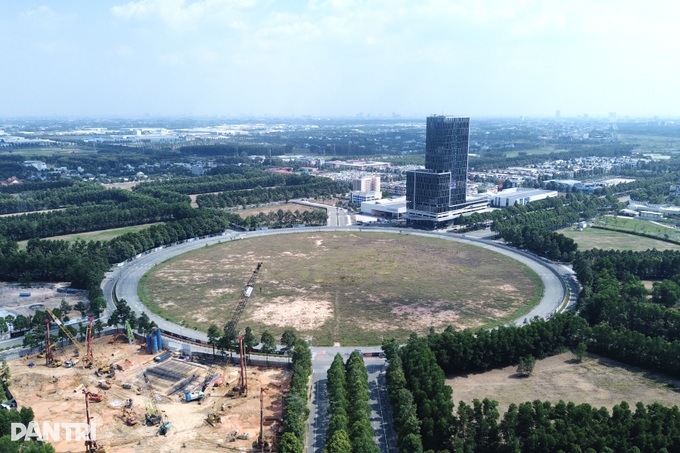
A1 Roundabout is expected to be the starting point of Metro Line 1, Binh Duong New City - Suoi Tien (Photo: Xuan Doan).
The proposal, submitted to the HCM City People’s Committee, covers Metro Line 1 linking Binh Duong New City with Suoi Tien, and Metro Line 2 connecting Thu Dau Mot with HCM City.
Metro Line 1 will stretch over 32 kilometres, including a main line of more than 29 kilometres and a 3.43-kilometre depot connection. The route will run from S1 Station in Binh Duong Ward to Suoi Tien Bus Station, with 19 stations and one depot.
The project is expected to cost around VND 64.37 trillion (about USD 2.5 billion), including land clearance expenses of approximately VND 8.03 trillion (about USD 313 million).
Metro Line 2 will extend more than 24 kilometres, linking S5 Station of Metro Line 1 in Binh Duong Ward to Hiep Binh Station on Metro Line 3. It will include 14 elevated stations and one depot.
The estimated investment for the second line is about VND 59.97 trillion (around USD 2.34 billion), with land clearance costs of roughly VND 15.67 trillion (about USD 610 million).
Both lines are designed for a maximum speed of 120 kilometres per hour and an operational speed of 110 kilometres per hour.
The consortium said the projects would be developed under a transit-oriented development model, using public-private partnership mechanisms such as build-operate-transfer and build-transfer contracts, aiming to mobilise private capital and reduce pressure on the state budget.
It has requested approval to conduct detailed research using corporate funding and to submit investment plans within three months of receiving permission.
The investors aim to complete legal procedures this year, begin construction in the first quarter of 2027 and bring the lines into operation by 2030.
The consortium also pledged to bear all costs and risks if the proposal is not approved in accordance with regulations.