
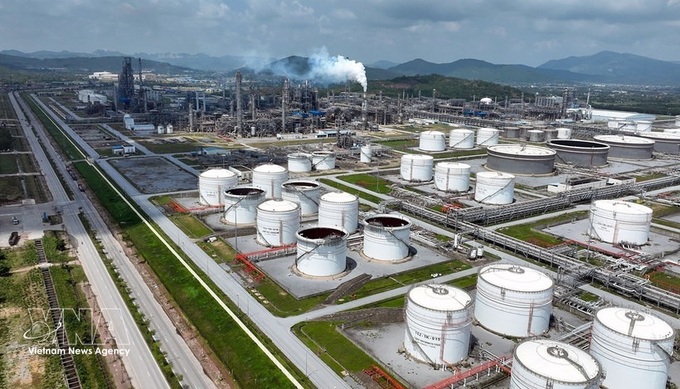
According to Nguyen Hong Minh, former deputy director of the Vietnam Petroleum Institute under Petrovietnam, the country both exports crude oil and imports feedstock for refining at Dung Quat Refinery and Nghi Son Refinery.
Since the two refineries became operational, Vietnam has been able to meet about 70 per cent of domestic fuel demand, with the remainder covered by imports.
Following disruptions to global supply chains, Petrovietnam has implemented response measures in line with the government’s Resolution 36 to ensure stable energy supply.
The group has proposed suspending crude exports to prioritise domestic refining, while reviewing feedstock sources and securing additional imports through international partners. It is also supporting Nghi Son Refining and Petrochemical LLC in signing new crude supply contracts.
Meanwhile, Binh Son Refining and Petrochemical is operating the Dung Quat Refinery at above full capacity to boost output and support supply if needed.
By the end of March, the refinery is expected to receive ethanol from domestic producers for blending into E10 RON95 fuel, further increasing supply.
Customs data show Vietnam imported more than 533,000 tonnes of petroleum products in the first half of March, up 41.4 per cent in volume, with import value rising 89.2 per cent amid price volatility.
Domestic supply has remained stable thanks to diversified sourcing, proactive imports and flexible use of the fuel price stabilisation fund.
Major distributors including Petrolimex and PVOIL have secured ethanol supplies from domestic producers and imports from the United States and Brazil to support biofuel blending.
Together accounting for nearly 70 per cent of the market, the two firms have expanded storage capacity and upgraded blending systems to accelerate the shift towards E10 RON95 fuel.
Bui Ngoc Bao of the Vietnam Petroleum Association said logistical challenges remain due to long transport distances, calling for policy adjustments to facilitate imports and bonded storage.
Energy experts said Vietnam should build a strategic national fuel reserve system to strengthen resilience against external shocks.
Ha Dang Son of the Centre for Energy and Green Growth Research also called for greater flexibility for Petrovietnam in expanding exploration and securing long term crude contracts, alongside stronger coordination between the state and enterprises to safeguard energy security.