
Organisers said more than 50,000 people have registered to take part in the mass ao dai display, underlining the growing appeal of the event across the community.
Trinh Thi Thanh, standing vice president of the Ho Chi Minh City Women’s Union, said this year’s mass performance is expected to gather more than 3,000 participants in person at three main venues: Nguyen Hue pedestrian street, the Tam Thang tower area in Vung Tau and the Becamex administrative centre in Binh Duong.
“This will be the largest scale event to date,” Thanh said, adding that groups will perform to music, creating a vivid spectacle of colourful ao dai in the heart of a modern urban centre.
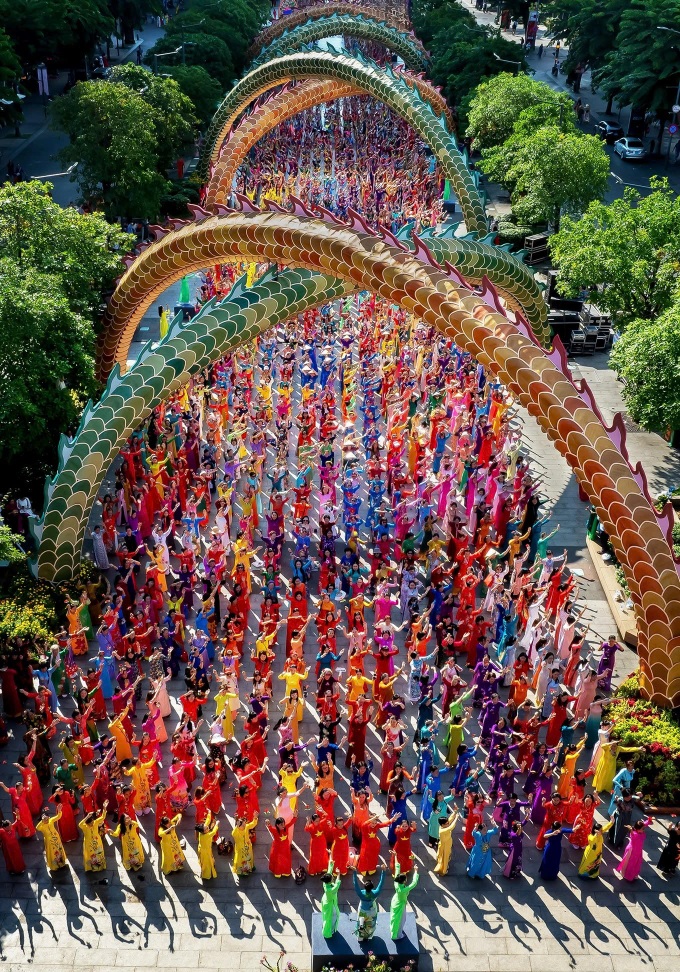
Ao dai mass performance during the 11th Ho Chi Minh City Ao Dai Festival held in 2025 (Photo: Organising Committee).
According to the organising committee, the festival will also feature a series of fashion showcases bringing together 37 designers from across the country, presenting nearly 400 ao dai designs.
Featured designers include Viet Hung, Do Trinh Hoai Nam, Adrian Anh Tuan, Do Long and Dinh Van Tho.
The collections will be presented at the opening night on March 6, portraying the evolution of tradition within the flow of modern life.
Alongside artistic performances, the festival will host a range of activities, including the final of the Ho Chi Minh City graceful ao dai contest, an online ao dai photo competition, a children’s ao dai design contest, interactive exhibition spaces at Nguyen Hue pedestrian street and metro stations, and free ao dai try on sessions for visitors.
This year’s programme will also see the participation of diplomatic representatives, consular spouses and international students studying in Ho Chi Minh City, helping to bring the image of Vietnam’s ao dai closer to the international community.

Over 400 ao dai collections will be showcased at this year's Ho Chi Minh City Ao Dai Festival (Photo: Moc Khai).
Speaking at a press conference on March 3, Le Truong Hien Hoa, deputy director of the Ho Chi Minh City Department of Tourism, said that over the past 11 years the festival has played an important role in preserving and promoting the cultural value of the traditional garment, while generating positive socio economic impacts, stimulating tourism demand and supporting the creative industries.