
A serious structural failure on span 18 of Long Bien Bridge has forced railway authorities to seal off the Hanoi-Gia Lam section to prevent safety risks.
Vietnam Railways said late on February 6 that severe damage was detected at 6.15 pm on February 2 during a routine inspection of the historic bridge. The defect posed a direct threat to structural integrity and traffic safety.
Following the discovery, the railway sector immediately suspended operations on the Hanoi-Gia Lam section and adjusted routes for passenger and freight trains passing through the area. Services on the Hanoi-Haiphong line were reorganised to pick up and drop off passengers at Gia Lam Station to minimise disruption.
Authorities have deployed round the clock monitoring and protection teams on both sides of the bridge. A temporary support system using steel frames and pile columns has been installed to reinforce the damaged truss joint.
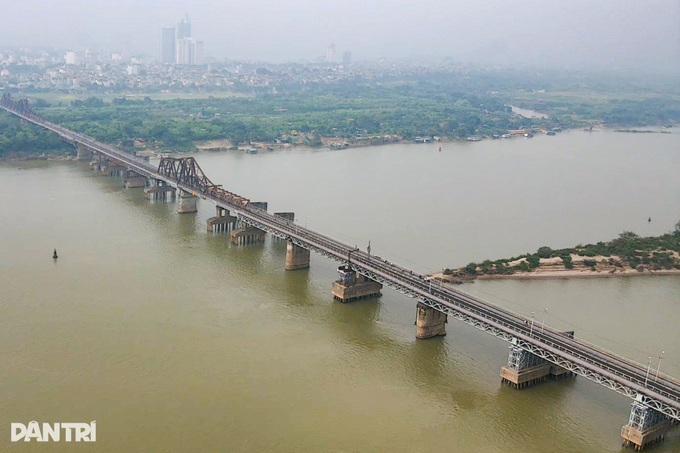
Long Bien Bridge (Photo: Thanh Dong).
Emergency repairs are under way and are expected to be completed by February 11, after which load testing will be carried out. If safety requirements are met, rail authorities will consider allowing light trains to resume operations across the bridge.
In the longer term, a comprehensive inspection of span 18 will be conducted, alongside assessments of the remaining spans to identify early risks of similar damage and propose appropriate reinforcement measures.
The incident has triggered a chain reaction across northern Vietnam transport networks, raising concerns about disruptions to freight and passenger flows from routes linking Lao Cai and Haiphong with Hanoi.
To avoid congestion in the days leading up to Tet, Vietnam Railways has activated contingency plans. Passenger services on the Hanoi-Haiphong, Hanoi-Lao Cai routes and the Nam Cua O tourist train have shifted their terminal operations to Gia Lam Station instead of Hanoi Station.
Freight transport has been diverted to cross the Thang Long Bridge.
Pham Anh Tuan, deputy director of the Hanoi Railway Operations branch, said trains from northern provinces are currently being routed via the belt line due to the Long Bien Bridge incident.
Previously, the belt line handled only five to eight trains per day, but traffic has now increased to 15,20 services daily, rising to as many as 30 during peak periods. Authorities have urged enhanced public awareness among residents living along the railway to ensure safety amid the increased traffic.
Spanning the Red River on the Hanoi-Dong Dang railway line, Long Bien Bridge was built between 1898 and 1902. The structure is about 1,700 metres long and originally comprised 19 steel truss spans, with a central railway track and pedestrian walkways on both sides.
Despite multiple rounds of repairs and reinforcement, deterioration of the steel structure has continued, marked by corrosion and sectional loss in truss members and joints. Many underlying defects remain difficult to predict, forcing the bridge to operate under strict limits on load and speed.