
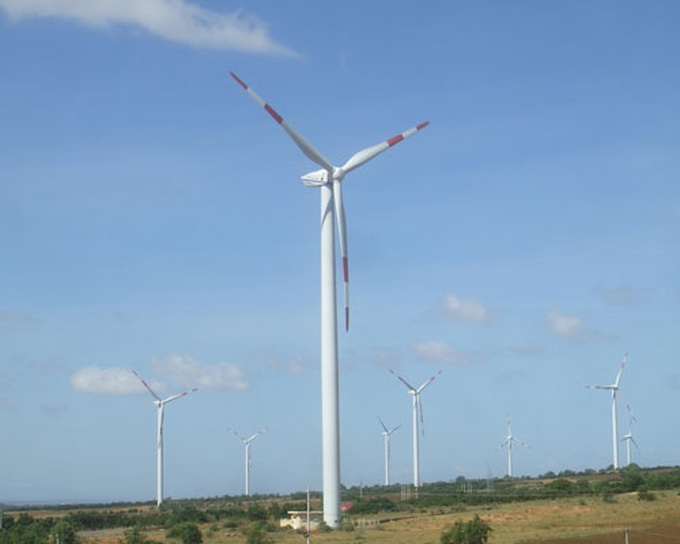
The southern central region saw a bloom in the number of wind-power projects several years ago. However, those projects that failed to be completed and put into commercial operation before December 31, 2020 didn't get preferential pricing policies within 20 years, leading to the investors incurring losses.
As of April 5, as many as 13 firms operating wind power projects in the region reported losses for 2022 on the Hanoi Stock Exchange.
Among the loss-making firms, Nam Phuong Energy Investment JSC posted a loss of VND372.40 billion, IA Pet Dak Doa Wind Power Plant 1 JSC VND209.50 billion, IA Pet Dak Doa Wind Power Plant 2 JSC VND201 billion, Phuoc Huu-Duyen Hai Wind Power Company Limited 1 VND60.30 billion, Cho Long Wind Power JSC VND35.60 billion; and Yang Trung Wind Power JSC VND91 billion.
Ninh Thuan Energy Industry JSC also reported a loss of more than VND106 billion in 2022, and another loss of VND22.76 billion in 2021.
Hoang Son Joint-Stock Investment Power Construction Trade Company 2 recorded a loss of VND80 billion in 2021 and further VND66.50 billion in 2022, while BB Power Holdings JSC reported a loss of VND153 billion in 2022 and another VND79 billion in 2021.
The losses were attributed to wind power investors not turning on electricity in time after the feed-in-tariff (FiT) regulation expired, the changes in electricity purchasing policy and the lingering impact of the Covid-19 pandemic.
In addition, renewable energy projects often have large capital requirements but high risks due to capacity and output being dependent on weather and climate, prolonging the payback period. Meanwhile, financial institutions and commercial banks are not willing to lend or lend at high interest rates.
Moreover, instability in the corporate bond market in the past time has forced businesses to buy back bonds ahead of time while projects have no cash flow, thereby putting many renewable energy businesses at risk of a cash flow crisis.
Changes in policy were also a reason for investors to be discouraged. At the beginning of 2023, based on calculations from state utility Vietnam Electricity, the Ministry of Industry and Trade issued the electricity price bracket for transitional solar or wind power plants in Decision 21/QD-BCT after a long time of being stagnant.
However, this price bracket is 21-29 percent lower than the FiT price mechanism, while not all projects record effective profitability.
Transitional wind and solar projects are those that missed the government's deadlines to obtain its favourable pricing policy, known as FiTs.
ACBS Securities believes that the new price level for transitional renewable energy falling too deeply will lead to negative cash flow and profits.
ACBS noted that as interest rates remain high and the USD/VND exchange rate has not shown any signs of cooling down in the long term, unstable financial models would discourage private capital to flow into renewable energy projects in the future. This would significantly affect the target of emission reduction toward net carbon zero by 2050 as committed by the government at COP26 and 27.
Meanwhile, VNDirect security company argues that the new price bracket provides the first rescue signals for energy developers, as projects have been stalled for a long time after the expiry of the FiT incentive.
"However, with this price bracket, not every project will record effective profitability," the company said.
"Given Vietnam's strong commitments at COP26 as well as significant adjustments in the Draft Power Development Plan VIII with the proportion of renewable energy power capacity increasing, we still expect an enough attractive pricing policy, luring qualified investors to participate in this field," VNDirect added.
VNDirect believes that businesses with the ability to improve development and operating costs, as well as the ability to mobilize cheap capital would have the advantage in this period.