
The World Wide Fund for Nature (WWF) has been collaborating with the Long An Provincial Department of Natural Resources and Environment to carry out various waste treatment activities including piloting a model on waste separation at source; separately collecting the sorted waste; and producing compost fertilizer from sorted waste in Tan An City.

Distributing trash bins for households in Tan An City
Domestic solid waste collection in the province was estimated to be between 570 and 590 tonnes per day in 2020. Tan An city, in particular, generated approximately 130-150 tonnes of waste per day, at a cost of approximately VND130-150 million per day for collection and treatment. Tam Sinh Nghia, a facility located in Long An, is capable of processing 240 tonnes of waste per day. However, many districts are either discharging waste into their own landfills or incinerating waste themselves, or even transporting waste to the treatment facilities in neighboring Ho Chi Minh City.
WWF-Vietnam is implementing the Long An Waste Management project as part of the Mitigating Marine Plastic Debris in Vietnam project, with the approval of the Long An Provincial People's Committee and funding sources from the Ministry of Environment, Nature Conservation and Nuclear Safety of the Federal Republic of Germany and Kaldewei, a leading manufacturer of steel enamel in Germany.
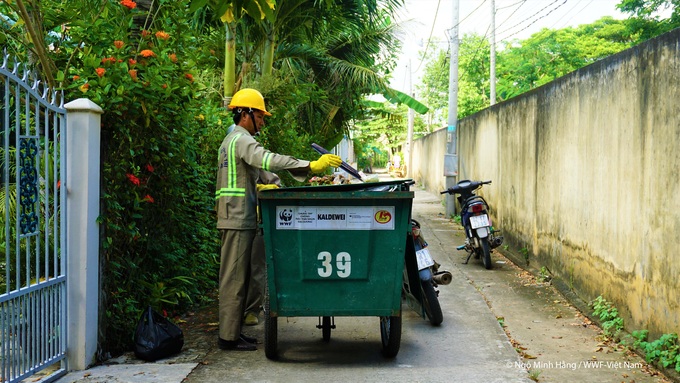
A worker collects waste in Tan An City
To date, the project has supported the development of the province's Waste Management Action Plan, and implemented a pilot model of waste separation at source in Ward 3, Tan An City, with over 4,800 households. The project also funded necessary equipment including approximately 10,000 trash bins for households, two box trucks for separate collection of sorted waste, as well as promoting the benefits of waste sorting and providing training to approximately 1,000 officials and residents on waste separation at source.
WWF-Vietnam has also launched a communication campaign to encourage the local community to separate waste at source.
WWF-Vietnam Project Manager, Trinh Thi Long said that WWF-Vietnam worked to assist local residents in understanding the importance and benefits of waste separation at source.
"We hope individuals shall alter their attitudes toward plastic waste to extend the life of plastic materials and conserve sustainable natural resources," she said. "Only then will we be able to fully utilize the plastic material, advance a circular economy, and contribute to Vietnam's environmental protection and climate change response."