
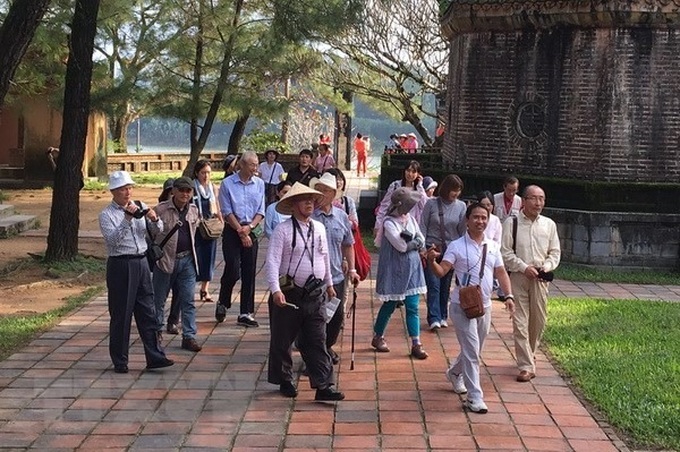
Japanese tourists visit Thiên Mụ Pagoda in Hue
Thailand, Vietnam and Philippines are key Asian destinations for Japanese tourists, he said at a conference on Vietnam- Japan Tourism Development held on September 7 in HCM City.
More airline seats, an increase in overseas travel among youth, and more local holidays have all contributed to overseas travel among Japanese tourists.
Seniors with money and time are the most important segment of Japanese tourists to Vietnam, according to Murai.
Females who travel for leisure are the most influential segment, while families with three generations of travel experience are also attractive segments that could be developed further.
Business travel to Vietnam has also grown strongly in recent years.
Murai said that Japanese preferred staying at beach resorts and visiting world heritage sites, and having impressive and surprising experiences.
Popular destinations in the central region in Vietnam are currently most favoured by Japanese tourists because of beautiful beaches, world heritage sites and natural resources.
Hạ Long Bay in the north and HCM City in the south also attract a large number of Japanese tourists.
More than half of Japanese tourists to Vietnam visit HCM City, an ideal destination for shopping, dining, fashion and educational tours, according to Murai.
To lure more Japanese visitors, he said that tourism authorities in HCM City should develop new tourism spots and enhance the quality of tour guides as well as promotional activities. Relaxing Vietnam’s entry visa regulations for Japanese would also be helpful.
Close business relations between the two countries should also be tapped to expand travel from Japan to Vietnam.
To increase the number of repeat visitors, quality of services should be enhanced, according to Murai.
Kanda Mizuho, assistant director of the ASEAN - Japan Centre’s Tourism & Exchange Division, said the number of Japanese outbound travelers to countries in ASEAN last year totalled 17.8 million.
Last year, Vietnam welcomed 798,100 Japanese tourists, up 7.8 per cent compared to the previous year.
The most common concerns among Japanese overseas travellers are safety, language barriers, anxiety about health, and cumbersome travel applications and procedures.
School trips
Vietnam is popular for overseas education trips organised by high schools in Japan due to low costs, safety, and good relations with Japan.
The number of overseas school trips to Vietnam rose to 17 in 2016 from only four trips in 2014.
Overseas school trips focus on foreign history, politics, economy and culture as well as exchanges with local schools and visits to Japanese companies in Vietnam.
However, limited flight seat capacity, evening flights, temperature differences, food, and traffic are among the factors hindering Japanese student trips to Vietnam.
Đinh Ngọc Đức, director of the Vietnam National Administration of Tourism’s Tourism Marketing Department, said the national tourism development strategy had identified Japan as the most important source market of tourists.
Japan is currently among the top three source market for tourists in Vietnam, with China and South Korea taking the first and second spots.
In the first eight months of the year, Vietnam welcomed more than 465,000 Japanese tourists. The country targets one million Japanese tourists by 2020.