
Many women in the Mekong Delta region who married to South Korean men and are facing difficulties have been supported by a project jointly launched by Can Tho City’s Women Association and Korea Centre for United Nations Human Rights Policy (Kocun).
The South-Korean funded VND11.4 billion (USD518,181) Korea-Vietnam Caring project aims to provide financial aid, legal consultancy, language training and care to Vietnamese women married to South Korean men, their multicultural families and children in Can Tho city and the Mekong Delta provinces.
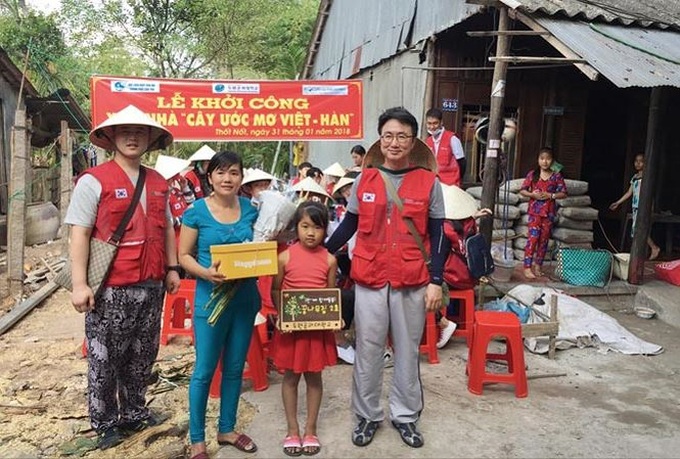
Korea-Vietnam Caring project supports a Vietnamese woman who married to a South Korean man
The centre also includes a South Korean-Vietnamese culture library, which is expected to help mixed children integrate into the local community. Classes on the Korean language and South Korean culture and multicultural family assistance policies will be offered to South Korean-married migrant women while providing legal aid on divorce procedures, vocational training and job placement for Vietnamese brides returning home.
According to the Can Tho Women’s Association, during the 2000-2017 period, up to 18,987 local women married foreign men, with 1,089 having South Korean husbands. According to a survey from the association and Kocun, by late 2016, 174 had returned Vietnam. Can Tho Provincial Police Department reported that by October 2017, 155 children with South Korean nationality were living in Can Tho City.
In 2004, Nguyen Thi Thu Ha in Trung Kien Ward, Can Tho City, married a South Korean who lived in Seoul. Due to cultural differences, she did not have a happy marriage and left Seoul to return Vietnam in 2010, taking her son with her. Since then, she and her son have had to live with her parents due to financial difficulties. Recently, she has been provided a financial assistance of VND80 million (USD3,636) by Korea-Vietnam Caring project to build a new house.
Dang Thi Thanh Thuy in Thot Not District, Can Tho City also got married to a South Korean man. However, because of the family conflicts, she brought her two daughters back Vietnam. She then left her children with her parents and now works in Malaysia.
The Korea-Vietnam Caring has helped Thuy’s family to build a new house.
Diep Thi Thu Hong, the chairwoman of Can Tho City’s Women Association, said that cultural differences and the language barrier were the main reason for Vietnamese women to leave South Korea as these result in family conflicts.
After coming back Vietnam, many face difficulties to settle divorce procedures due to regulatory differences between the two countries. Many return to Vietnam without papers such as marriage certificates, which affects the rights of their children.
Many women return and are unemployed and emotionally affected by the experience. They often leave their children with their parents to earn a living in cities.