
Officials from the Ministry of Agriculture and Rural Development discussed discharge from hydropower plants after the central region suffered from serious flooding.
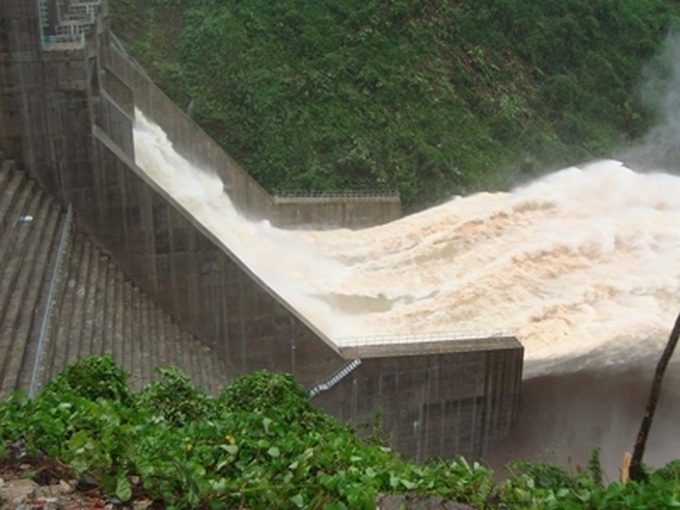
A Vuong Hydropower Plant discharges water
According to Le Huy Ngo, former Minister of Agriculture and Rural Development, storms mostly occurred during the final months of the year and this November has seen heavy rains, adding that countries will need to develop their power plants. However the balance of nature is tipped significantly when investors want profits and built large reservoirs while rivers in the central region remain small. In addition, deforestation adds to this unbalanced scale.
While many people think that hydropower plants do more harm than good, Ngo said it is not the complete truth, as nature can still cause severe damage.
He went on to say that the problem is centred around several plants that seem to focus on power generation job and forget their other duties of flood control and water retention in dry seasons. He said that it is necessary to issue strict punishments for those power plants.
"The people should have power to supervise hydropower discharges and the Ministry of Nature Resources and Environment (MNRE) should be held responsible for designing those regulations. The National Centre for Hydro-Meteorological Forecasting should also be under the MNRE's control." he said.
Meanwhile, the deputy Minister of Agriculture and Rural Development Hoang Van Thang said the management and operation of reservoirs are ineffective. He said, "After receiving news about heavy rains, reservoirs' owners would discharge water but they will complain about the lack of water for production. Some reservoirs only discharge little water and often experience overflows when the floods arrive."
Currently, Vietnam has about 7,000 lakes and reservoirs, and 70% of them are mini-sized. Authorities are urged to carry out urgent inspection in order repair and remove unsafe reservoirs. Moreover, residential areas in the downstream should be relocated out of danger zones and make it easier for emergency rescue work.
Speaking about the damaged reservoirs during the recent floods, most of which were already labeled as deteriorated reservoirs, Thang said harsh weather was the main factor.
"Several central provinces often suffer from heavy rains, such as Thanh Hoa and North Nghe An. A chairman in Binh Dinh Province once told me that it took 2 days for flood water to arrive, but it only takes 7-8 hours now. We have to improve our forecasting ability and keep an eye on both weak and good reservoirs," he said.
According to Thang, the authorities are carrying out inspections at all of reservoirs and checking the curriculum at Water Resourses University.