
The report came in an urgent message called by National Steering Committee for Flood and Storm Prevention and Control and the National Committee for Search and Rescue to northern coastal areas and central provinces stretching from Thanh Hoa to Phu Yen.
According to the National Hydro-meteorological Forecasting Centre, typhoon Utor, the strongest of its kind in the region so far this year, was located 450km from Hoang Sa (Paracel) archipelago on the morning of August 13 with packing winds of 149kph near its centre.
 |
The Ministry of Foreign Affairs has sent a diplomatic note to the Chinese Embassy in Hanoi, asking them to help fishermen find shelter and conduct search and rescue operations when need be.
Earlier, the two national committees met to discuss measures against super storm Utor which made landfall on Luzong island, the Philippines on the afternoon of August 12, causing great property damages and human losses for the island nation.
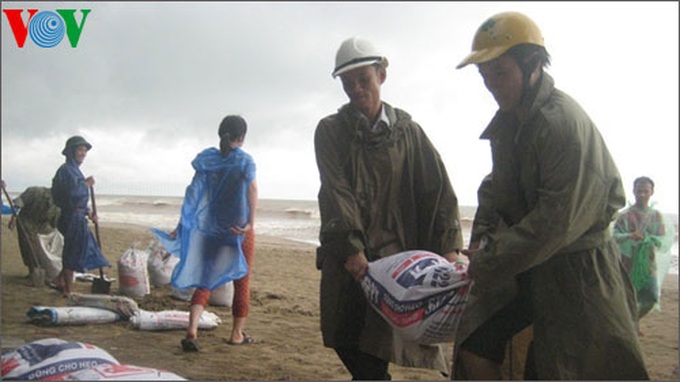
Nearly 300,000 workers in provinces from Quang Ninh to Ca Mau have been warned to move out of danger areas.
Currently, 1,142 vessels with around 11,000 people on board are still in the northern and central parts of the East Sea including the waters near Hoang Sa and Truong Sa islands.
Colonel Vu The Chien from the National Committee for Search and Rescue reported that 76 fishing vessels belonging to Quang Binh are on their way back to shores.
The National Hydro-meteorological Forecasting Centre has predicted that after entering China’s Lei Zhou island, Utor will regain strength with packing winds of up to 13-14 category in the Tonkin Gulf.
Le Thanh Hai, Deputy Director of the National Hydro-meteorological Forecasting Centre said the storm will become stronger in the next two days and directly affect northeastern provinces, especially Quang Ninh and Mong Cai as there will be heavy rains in the next three days (August 15-17).
Minister of Agriculture and Rural Development Cao Duc Phat asked authorities to closely monitor the movement of the storm, guide ships and vessels at sea to find shelter and make plans to reinforce reservoirs and dams.