
Despite making great efforts to improve the quality of domestic cosmetics, Vietnamese products are still regarded as inferior to their foreign rivals.
According to the HCM City Chemical Cosmetics Association, by September this year, Vietnamese cosmetics companies had launched hundreds of products with various brands, but they accounted for just 10% of local market share. Meanwhile, the remainder is held by foreign products.
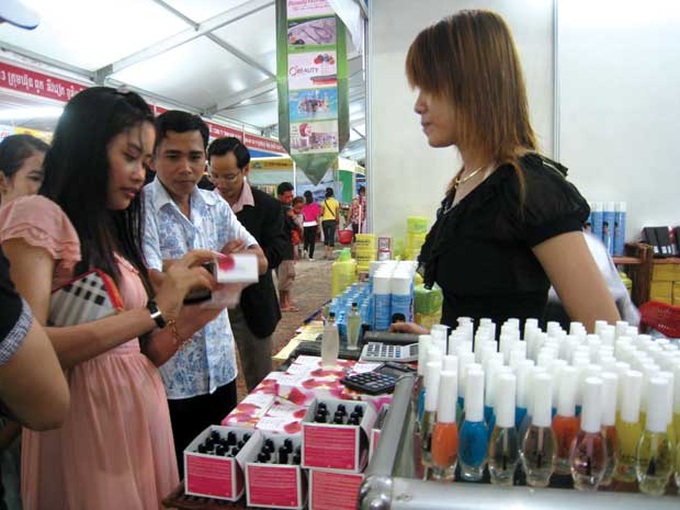
Vietnamese cosmetics products are widely used in Cambodia, but they fail to attract local customers.
International brands
Nguyen Thi Thanh from Tan Binh District has used a domestically-made face powder named Two Way Cake produced by Thorakao for some years. She has found that it is very suitable for her skin and cheap at just VND64,000 (USD3.4) per box. “However, it’s not a famous brand so I don’t want to show it off in front of my colleagues,” she confessed.
Mrs. Trang Anh, who uses Vietnamese cosmetics at a beauty salon on Le Thanh Ton Street in District 1, opposite Ben Thanh Market, said “When I show my customers Made-in-Vietnam products, they just stare at me. I know that most of customers around here just prefer famous brands. No shop around Ben Thanh Market sells Vietnamese cosmetics.”
She used foreign products, but finally found domestic goods were more suitable for her, so she hasn’t hesitated in showing them off in public.
Nguyen Thi Be in Binh Thanh District is a fan of Vietnamese crocus cream over the last five years. “I have used many different kinds of imported cream, but they’re no better than crocus cream, while they’re very expensive. A tub is just VND12,000 (USD0.57),” she added.
Natural materials
Vietnamese cosmetics products are often made from natural materials such as coconut oil, lemon, grapefruit, citronella, crocus and soapberry. However, shampoo extracted from soapberry by Lana, Saigon Cosmetics and Thorakao fails to draw customers who prefer similar products manufactured abroad.
Luong Van Vinh, Director of My Hao Cosmetics Ltd. Company, who started his business by producing soap, said, “Previously, Vietnamese companies produced soap using coconut oil, but now, they have also followed the world trend to use palm oil. Foreign industrial firms turned palm oil into soap and Vietnamese producers buy it while mixing it with colours and scents to make their own products.”
Pharmacist Huynh Ky Tran has spent much time researching crocus-extracted soap which helps to make the skin become whiter. However, sales of this product are much slower than Camay’s own product.
While allegedly Thorakao’s face powder is as good as foreign manufactured alternatives, it's sales have only increased by 15%.
The sale of Vietnamese cosmetics remains modest and they almost are unable to compete with foreign brands.
According to the HCM City Chemicals Cosmetics Association, Vietnam is now home to 430 chemicals and cosmetics producers and businesses, yet foreign products account for over 90% of the domestic market share.