
Despite the slowing in sales of Chinese goods, Vietnamese companies have not filled in the gap.
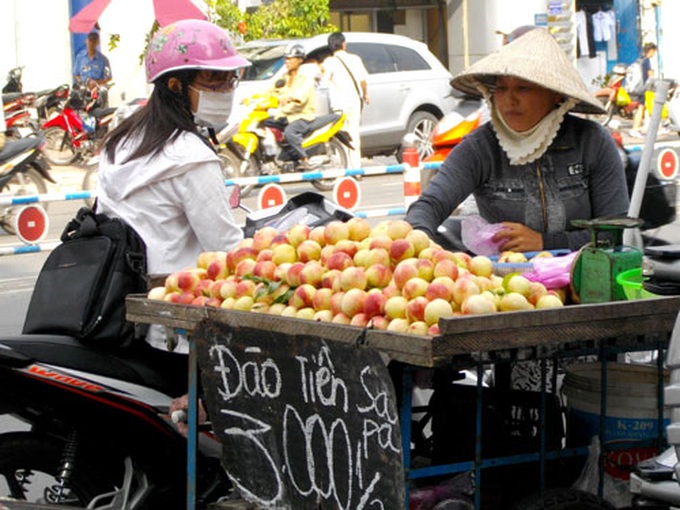
Chinese peaches with Sapa labels easy to find
Chinese products attract fewer customers
Over the past month, Vietnamese customers have tended to turn their backs on Chinese products, particularly clothes and agricultural products, after publicity about their low quality.
Thu Duc and Hoc Mon wholesale markets in HCM City, the largest outlets for Chinese products, saw a 30% fall sales of Chinese goods compared to last year.
Nguyen Thanh Ha, Deputy General Director of Thu Duc Wholesale Market, said that around 70-80 tonnes of Chinese vegetables and fruits are imported into the market every day, accounting for 10% - 15% of the market’s total products. Now, the market mostly imports popular goods such as onions, garlic, cabbage, potato and grapefruit from China, but they have now fallen out of favour with Vietnamese customers. Chinese produce only sells well when there are not enough domestic products, she said.
Chinese potatoes are priced at VND12,000 per kilogramme, compared to VND28,000 for Dalat potatoes, nevertheless, customers still prioritise domestic products. Some sellers tried to mix Chinese potatoes with red soil to make them look like those grown in Dalat, Ha added.
Chinese clothes and footwear traders also complain over poor sales. Thanh Hoai, owner of a fashion shop on Nguyen Trai Street, District 5, HCM City, said “I used to come to the Mong Cai border in Quang Ninh Province to get Chinese products and resell them to shops. But for the past two months sales have gone down."
Vietnamese companies fail to take advantage
In spite of the drop in sales of Chinese products, Vietnamese companies haven't taken advantage of the situation as many expected.
Dr. Vo Mai, Vice Chairman of Vietnam Gardening Association, said Vietnamese fruits and vegetables are high-quality and abundant. Even though there are exports to countries like Thailand and China, inferior technology has set the industry back.
“Traders care about profits, which means that at times they force growers to produce quick, cheap goods at low cost. The situation has been slowing down the development of this industry for years," he said.
Farmers are currently looking to the State for help in finding markets for their produce.
The Vietnamese garment and textile industries also find it hard to compete with Chinese because of the low overhead needed by their foreign rivals, and because the "Made in Vietnam" tag has often been used by foreign companies.
According to the Vietnam Textile and Garment Association, domestic supply sources only meet 0.75% of cotton demand and 30% artificial fiber. At the same time companies have to import 100% of machines and 70% of other materials.