
Greece began a second day of coalition talks on Tuesday under the gun from financial markets and world powers after elections won by a pro-euro party that also reflected rising anger against austerity.
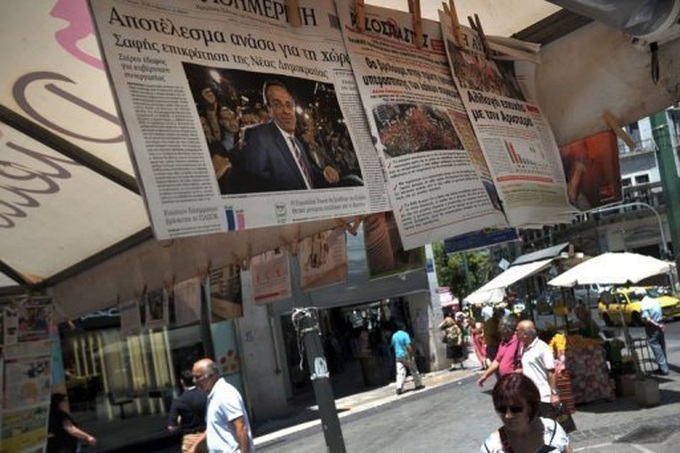
Greece starts a second day of coalition talks under the gun
The New Democracy conservatives were negotiating a possible coalition with socialists Pasok and the Democratic Left party after clinching a narrow victory against radical leftists Syriza who want Greece's EU-IMF bailout deal torn up.
The three parties "are close to a deal," the socialist daily Ethnos reported.
Pasok leader Evangelos Venizelos has voiced hope that a coalition will be announced later on Tuesday and Democratic Left leader Fotis Kouvelis said that it was possible "within the next few hours, if we reach agreement."
After meeting with Kouvelis, Venizelos said coalition talks were being "sped up" and added: "Greece must and will have a government as soon as possible."
New Democracy chief Antonis Samaras, a 61-year-old former foreign minister educated at Amherst and Harvard in the United States, won 129 of the 300 parliamentary seats on Sunday, Syriza won 71, Pasok 33 and Democratic Left 17.
The results of Greece's most important elections since the end of military rule in 1974 eased fears of an immediate euro exit but any new government faces a potential stand-off with its EU-IMF creditors over the terms of the bailout.
The Greek state meanwhile only has enough cash reserves to pay public sector salaries and pensions to last until July 20 and the European Union and the International Monetary Fund have suspended loans until a government is formed.
Europe and the United States have urged Greece to move quickly to form a new government and enact the reforms it has agreed to in return for the loans.
Key creditors like Germany have held out the possibility of extending a key 2014 deficit-cutting deadline but say the content of the deal cannot be changed.
"There cannot be rebates, there cannot be deductions," German Economy Minister Philipp Roesler said after talks at the White House in Washington.
"The agreed-upon objectives must be achieved," he said on Monday.
Under the current conditions, Greece has to cut 11.5 billion euros (USD14.5 billion) -- the equivalent of five percent of its gross domestic product -- by 2014 although Greek parties wants this deadline to be pushed forward to 2016.
Speaking on the sidelines of the G20 summit in Los Cabos, Mexico, senior US official Lael Brainard said "there is ample room for both sides to sit back down" and hammer out a new deal giving Greece more time to meet its obligations.
"We expect to see on the part of the European partners and the IMF recognition that Greece's program has gone off-track for some period of time in part because they had a protracted political process," she said.
Samaras has promised to respect Greece's engagements but also said as he began coalition talks on Monday that there should be amendments to the bailout deal "so the Greek people can escape from today's torturous reality".
Samaras promised during his campaign that he would bring down property and sales taxes and put an end to pension and salary cuts.
He also vowed to crack down on undocumented migrants -- a key concern among many Greeks that helped the neo-Nazi Golden Dawn party win 18 seats.
In a country in its fifth year of recession where unemployment is at a record 22.6 percent he faces a thankless balancing act between growing pressure from the streets and a hard line from the global financial community.
Many Greeks are gloomy about their country's future.
"There is no Greek politician who can get the country out of this mess. Not one!" said Panayotis Dimopoulos, a pensioner in the streets of Athens.
"Samaras and Venizelos have already shown us that they can sign whatever (German Chancellor Angela) Merkel wants," he grumbled.
World stock markets initially rallied in reaction to Sunday's elections and the euro rose sharply against the dollar but the gains quickly petered out amid broader concerns about other indebted euro economies like Italy and Spain.
Asian markets mostly fell on Tuesday and European stocks were barely up.
Greece has been forced to seek bailouts twice after hiding the extent of its debt woes, first for 110 billion euros in 2010 and then for 130 billion euros earlier this year. It has also had a 107-billion-euro private debt write-off.
The eurozone is hoping the result can draw a line under a lengthy period of uncertainty that has unsettled markets in a country where the sovereign debt crisis kicked off in 2009 before spreading across the continent.