
Mini supermarkets specializing in selling foreign products from Korea, Germany, and Thailand have recently mushroomed in Hanoi, putting on shelf a number of products which are, however, not officially brought to the country.
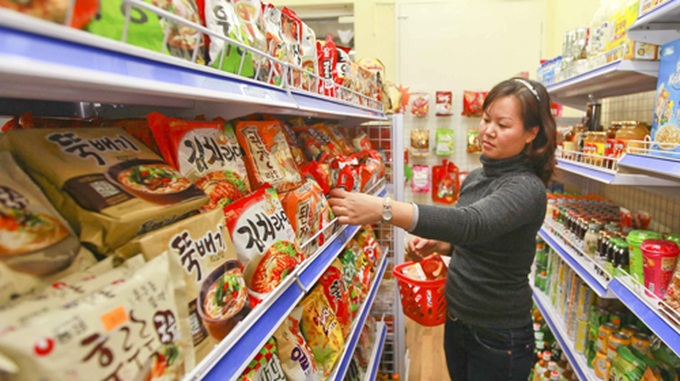 |
| A customer browsed for goods at EZ mart, which specializes in selling Korean products Photo: Tuoi Tre |
Another common characteristic of the supermarkets is their small area, which is usually around 30 – 60 square meters.
At the 30-square-meter Minimart Thailand at 291 Tay Son Street, for instance, a series of products, from shampoo, clothes, to confectionaries and soya milk are on sale, all of which have been brought from Thailand, according to Hung, the owner.
The minimart is always full of customers, though prices are higher than domestic ones.
Similarly, the supermarket specializing in Korean goods at 9 Ly Nam De Street sells beverages, confectionaries, and other Korean specialties.
The mart attendants also claim that all products originate from the land of Kimchi.
“Those without Vietnamese labels are hang xach tay, with quality ensured,” one of them confirmed.
The products are also more expensive than Vietnamese products. For example, a pack of sausage costs VND43,000, more than double the cost of a similar product manufactured in Vietnam.
What is worth noticing is that most of the customers of these foreign goods supermarkets are local citizens, according to Hoang Viet Ha, a minimart owner.
“Vietnamese customers are willing to pay high prices to buy the products to give as gifts, while foreigners usually choose locally-manufactured goods at lower prices,” she said, explaining why she has not opened new marts in areas with a large population of foreigners.
Ha said Korean food brought to Vietnam is usually on sale at prices 1.5 times higher than prices in Korea, since she has to hire people to bring them home via airlines, while the products have short expiry dates.
Most of the foreign mini supermarkets claim they have high revenues, and have planned to expand operations.
Quality under question
When asked about the origins of the goods, and how to handle the case of customers getting poisoned by the products, attendants at the minimarts always claim that “it is impossible for the goods to be of poor quality,” since “they are foreign products.”
Meanwhile, a large number of the goods on the shelf do not bear Vietnamese labels and manuals, making it hard for customers to know if the goods are genuine.
An official of the Market Management Agency under the Ministry of Industry and Trade said businesses are allowed to open supermarkets to sell imported goods as per Vietnamese law.
“However, the imported products must have invoices and receipts, with ensured origins and quality,” he said.
“They are also required to have labels in Vietnamese with specific information about the product features and expiry date.”