
White House hopeful Mitt Romney was Tuesday locked in a nail-biting battle with Rick Santorum in Ohio as he looked to tighten his grasp on the Republican presidential nomination.
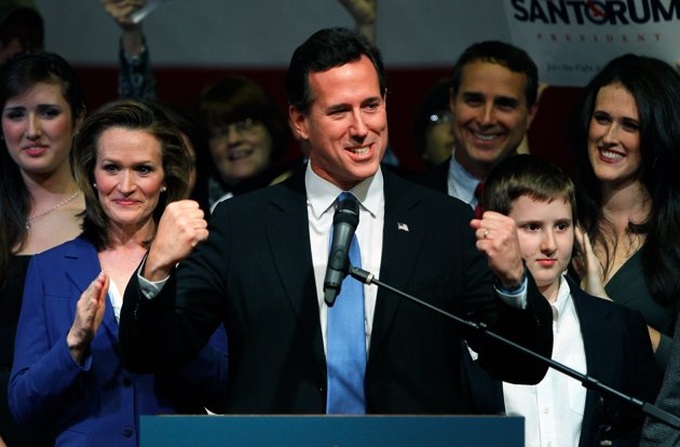 |
| Republican presidential candidate Rick Santorum speaks during the election night rally in Steubenville, Ohio. (AFP Photo/Joe Raedle) |
He also scooped wins in Virginia, Idaho and Vermont, television networks predicted, as the battle heated up to become the Republican standard-bearer to challenge Democratic President Barack Obama in the November elections.
Santorum, once the rank outsider in the contest, was snapping at Romney's heels winning southern Tennessee and Oklahoma, as well as North Dakota. In the latter race, he even beat Romney into third place.
A battle royale was under way in the key bellwether state of Ohio, where as votes trickled in the count was seen as too close to call, with Romney narrowly leading by just a few thousand votes.
The day's muddled results signal that the topsy-turvy race is likely to drag on for weeks, especially given the complex Republican nominating process where many states award their precious delegates proportionally.
"We're on our way. Your support really means everything to Ann and me. And I'm not going to let you down. I'm going to get this nomination," Romney trumpeted at a Boston rally, with his loyal wife Ann by his side.
"This president's run out of ideas. He's run out of excuses, and in 2012, we're going to get him out of the White House," he added to deafening chants of "USA, USA" and "We need Mitt."
In another sign of the volatile race, former House speaker Newt Gingrich won handily in his home state of Georgia.
According to exit polls, Gingrich had taken 48 percent of the Georgia vote, compared to 25 percent for Romney and 20 percent for Santorum.
"Thank you Georgia! It is gratifying to win my home state so decisively to launch our March Momentum," Gingrich tweeted.
"In the morning, we are going on to Alabama, we are going on to Mississippi, we are going on to Kansas, and that is just this week," he added later in his victory speech, comparing himself to a "tortoise" who can beat flashier "bunny rabbits."
But a fierce battle was taking place in Ohio with Romney on 38 percent to Santorum on 37 percent with 91 percent of precincts counted.
At a victory party in Steubenville, Ohio, Santorum loyalists cheered as CNN predicted he had won Oklahoma with some 34 percent to 28 percent for Romney.
Santorum, 53, a devout Roman Catholic who fiercely opposes abortion and gay marriage, has billed himself as an authentic conservative who understands working-class voters and can beat Obama in key midwestern battlegrounds such as Ohio.
"We have won in the west, midwest, south and we're ready to win across this country," he told a rally to ear-splitting cheers from supporters.
But Santorum's radical views have alienated some, and if he loses Ohio, serious questions will be asked about his electability.
Romney, 64, was hoping to win a majority of the 10 states in play on Tuesday and dispel lingering Republican doubts that he is the best candidate to take on Obama despite his Mormon faith.
Even after Tuesday though there will still be a long way to go in the state-by-state battle ahead of the Republican convention in August when the party's nominee will be crowned.
In Dublin, Ohio, Mark Kraft said he had found the choice tough.
"At the last minute I did vote for Santorum," the 51-year-old media monitor said. "It was like (the children's game) 'rock-paper-scissors' in my head."
Hank McCormick, 65, said he voted for Romney and attacked Obama for failing to deliver as hard-hit states like Ohio struggle to emerge from a painful recession with a stubbornly high unemployment rate of 8.3 percent.
"I want a businessman in there, someone who understands profit and loss and who can beat the opponent," he said. "Three and a half years ago, everybody was looking for some change. Now I'm looking for a reverse."
Andrew Debos, who voted for Gingrich in Tennessee, said: "It's one of the most important elections of my life because of the direction of the country. I don't like where it is going."
Delegates are awarded by each state in the complex Republican Party nominating process, with one candidate needing to reach 1,144 delegates to declare victory. More than 400 delegates are up for grabs on Super Tuesday -- nearly 40 percent of the total needed to secure the nomination.