
 |
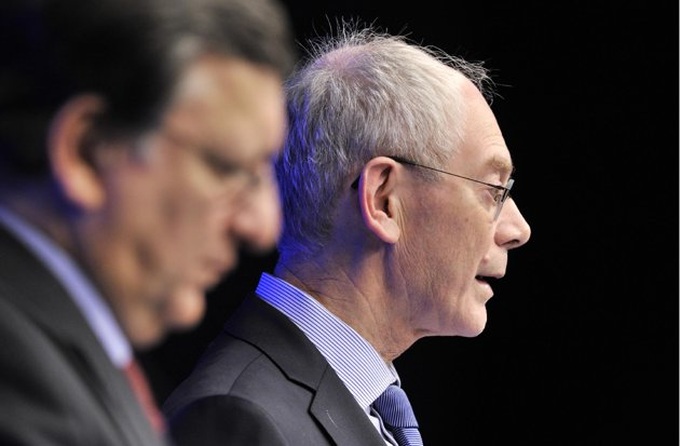
| European Council President Herman Van Rompuy (R) and European Commission President Jose Manuel Barroso speak at a joint press conference following a European Union summit at the EU headquarters in Brussels. |
Greek Prime Minister Lucas Papademos went immediately into post-summit talks with top officials from the EU and the European Central Bank (ECB).
In October last year, Greece was promised a second bailout of 130 billion euros ($171 billion) if it could convince private investors to write off 100 billion euros of debt.
That deal is still to be finalised, as is a reassessment of Greece's debt sustainability.
Eurozone partners' handling of the Greece issue in the intervening months reached a nadir when Germany at the weekend suggested placing the Athens government under wardenship.
"It would not be reasonable, not democratic and not efficient," French President Nicolas Sarkozy said of the plan put to finance ministries.
Greece's education minister had called the idea "the product of a sick imagination," and although Sweden and others showed sympathy, German Chancellor Angela Merkel did not push the plan further on this occasion.
Her finance minister Wolfgang Schaeuble told the Wall Street Journal that "unless Greece implements the necessary decisions and doesn't just announce them ... there's no amount of money that can solve the problem."
The EU focus on bailouts was supposed to give way at Monday's summit to a renewed push to stimulate growth and create jobs across European economies.
This idea even saw tentative moves to place an ambitious free-trade deal with the United States on the coming agenda.
But at its root was the announcement that 25 countries, even if one less than thought, had adopted the new pact on budgetary discipline.
The Czech Republic joined Britain on the outside looking in, but a threat by Poland to withdraw evaporated after France gave ground in an argument about giving non-euro countries a seat at future summits to decide eurozone economic governance.
Pushed by Germany and the ECB, the treaty -- to be formally signed in March -- will require governments to introduce laws on balanced budgets and impose near automatic sanctions on countries that violate deficit rules.
It will enter force after 12 nations ratify it, and only those countries that sign up will be able to access bailout aid from a new rescue fund whose legal basis was also ticked off at the talks.
With Italy and Spain still fragile, EU leaders also set up a permanent rescue fund to begin operations a year early in July, although they will discuss before then whether to boost its size from an initial 500 billion euro target.
Leaders had begun their day landing on a military airstrip to beat a Belgian general strike that grounded most public transport in protest at a new round of EU-ordered austerity.
European Commission chief Jose Manuel Barroso said 82 billion euros of unspent EU funds could be used to kick-start growth and job creation -- but with the catch that money is matched locally.
Stocks slid awaiting news on Greece, and Spain plunged quicker into what Brussels deems a "moderate" recession looming large over Europe.
In London, the FTSE 100 index of leading shares closed down 1.09 percent to 5,671.09 points. In Paris, the CAC-40 index shed 1.60 percent at 3,265.64 points and in Frankfurt the DAX 30 fell 1.04 percent at 6,444.45 points.
Leaders, some facing imminent re-election campaigning, must contend with an unemployment rate averaging 10 percent across the 17-nation eurozone.
They issued a statement on boosting growth in Europe, including such ideas as lowering the tax burden on employers to get more people hired, and giving all young people guaranteed options in work, training or study.
"There are no quick fixes. Our action must be determined, persistent and broad-based. We must do more to get Europe out of the crisis," the joint statement said.